I'll be the first to admit that I'm pretty pop culturally unaware. In fact, one of my partner's favorite party tricks is to name a slew of recent movies and ask how many I've seen. The answer is almost always none.
Perhaps my general ennui with Hollywood films is a subconscious (or not-so-subconscious) response to their portrayal of women. Now, I'm not going to rant about what you might expect -- women portrayed as sex objects, marriage-obsessed individuals, weaklings, or morons -- although there is plenty of that happening too. I'm not even going to point out how few women possess lead roles in major blockbuster films. (By the way, there's a great blog on all these issues, if you're a little more pop-culture or film savvy than I am.)
Instead, I today take issue with how career women are often portrayed as what NPR pop culture critic John Powers refers to as "bossy, uptight and utterly without personal lives. What they need, we're supposed to think, is a man. But before they can get one, they must have a mortifying comeuppance."
His story, "On Hollywood's Strong, Self-Hating Women," is a fantastic and balanced insight into yet another one of those gendered stereotypes that we as Americans have seemed to internalize without a second thought -- namely that career women are emotionless individuals who need to realize how much they need a man.
Powers' article offers several examples of films (again, none of which I've seen) in which Hollywood seems to unleash "dark, paranoid fantasies about unwomanly women and pushy shrews. It served up a parade of Prada-wearing devils." Powers attributes this oddly consistent image of women to a backlash against the feminist movement, fueled largely by a target audience of insecure adolescent men.
While it's great that professional women are becoming more common on the big screen, we need to get better at portraying them more realistically.
THE UGLY TRUTH trailer in HD
Friday, July 31, 2009
Hollywood keeps career women trapped in rigid stereotypes
Thursday, March 12, 2009
The Disney fairy tale wedding fantasy continues
First, a disclaimer: I am really a huge Disney fan. I grew up with all the classics, visited the theme park (even as an adult), and I still have my old Winnie the Pooh stuffed animal who is at least 2 decades old.
And while I'm thankful to Disney for teaching me that even roly poly bears like Pooh deserve to be loved for their fluff and stuff, and that, in the end, good usually triumphs over evil, I'm pretty mad at Disney for messing up my perceptions of love.
It took me a long time to recognize that despite my tomboy nature and my sense of independence, I too had fallen victim to the fantasy of the Disney fairy tale princess mentality. For most of my teenage and college years, I assumed that marriage would make me happy. I wore dresses to proms, dreamed of big diamond engagement rings, and planned out the perfect wedding in my mind.
And get this: I actually owned a wedding journal when I was all of 17 years old. You may be wondering, what in the hundred acre woods is a wedding journal? Well, I'll tell you. It's a place where you write down all of your wedding plans, like the following (which were actually part of said journal):
-Buy a dress with lots of tulle (which now makes me say "GOOD GOD, WHAT WAS I THINKING?")
-Give my husband the letter I wrote to him when I was 17. (I had written this letter to my future husband, whomever that might be. It was the cool thing to do as a Christian girl who wasn't allowed to have premarital sex. You were supposed to channel that energy to the imaginary man with whom you'd one day have s
ex and envision all the things that he would be. I've since wished that I could find this elusive letter to see all the ways that Joe DOESN'T meet my 17-year-old requirements... which is, of course, a very, very good thing.)
-Release butterflies at the end of the ceremony. (Little did I realize that to do this, the butterflies have to be shipped overnight, and some inevitably die in transit. Then, every guest gets a little box to open at the big "release" moment. After learning all of this, I had nightmares about my flower girl excitedly opening her box to a dead butterfly and spending the entire reception in tears.)
So the problem with all of these obsessive wedding-planning practices is that they perpetuate the Disney fairy tale myth, namely that marriage makes all stories end happily ever after. As most committed, monogamous couples know, the moment you pledge to stay together "as long as you both shall live" is the moment when things actually begin to get hard...really hard. And ten years later? Things get harder.
In short, Disney LIED!
Yet many heterosexual women rush into marriage, buoyed by the hope of eternal bliss that Disney so carefully portrays in Cinderella, Snow White, and Sleeping Beauty (the triad of princess classics). In addition, many women choose to stay in relationships that have long gone sour (or worse, that have turned abusive) because they cling to the idea that their marriage should be happy and their princess lifestyle should last and last.
So should it surprise us that beginning in 2007, Disney unveiled its line of princess-inspired wedding gowns? Here's what they have to say about every girl's socially constructed "dream":
The Gown, The Slipper, The Kiss and The Prince. Under it all, every girl believes in the dream. So here is our tribute to fairy tale wishes and finding true love.
Guess it's time to get out those wedding journals, ladies. (Just try to avoid the dead butterflies, if you can.)
Sunday, February 22, 2009
Oscars? Yup, still a boys' club.
The fact that the award itself is named after a man should tell us something, but many of us will still crowd in front of our television sets this evening and tell ourselves that this is a fair, unbiased representation of the best acting/directing/producing/artistic talent in the movie world.
However, when we polish our lil gender lenses, we'll find that this just is not the case.
Consider, for instance, what Melissa Silverstein of the Huffington Post points out (and this is just a sample):
-None of the Best Films Feature a Woman as the Lead
-Directing is Still a Boy's Club
-Women of Color Dominate the Supporting Actress Category Congrats to Viola Davis (Doubt), Penelope Cruz (Vicky Cristina Barcelona), Taraji P. Henson (The Curious Case of Benjamin Button). The best actress category is white and not a single of the male acting nominees are of color.
-A Woman Still Has Never Been Nominated for Best Cinematography
Hesse also points out that "the only categories in which women have more nominees than men are Best Actress and Best Supporting Actress."
I also have to recommend Monica Hesse's piece in the Washington Post, which asks, among other things, why we have a gendered Best Actor / Best Actress category in the first place. She also quotes the following 2008 study from the University of Southern California:
The study evaluated nearly 7,000 speaking roles in recent Oscar-nominated movies, finding that only 27 percent of those roles belonged to women. In films with female directors, however, the percentage jumped to 44 percent.
As I'm munching on popcorn and soft pretzels with friends, I'll be pondering the gender inequity of tonight's events while cheering on my favorite nominees. It's tough to do both at the same time, I admit. But alas, this is the plight of a feminist movie fan, is it not?
Posted by
Rebecca Lauren
at
2:28 PM
0
comments
Labels: arts, media, movies, television
A little "Changeling" needed for gender roles
Last night, my partner and I finally got a chance to watch The Changeling, directed by Clint Eastwood and starring Angelina Jolie. I'd been anticipating this movie since it's release months ago, and now that it's out on DVD, my expectations had grown to gargantuan proportions.
And I can't say I was disappointed. My partner, Joe, actually cried at this film, and anytime Joe cries at a movie, it gets two thumbs up from me. (My tear ducts are a bit less reliable, as anyone remotely familiar with my gene pool will tell you.)
The plot followed real events in 1928 when a boy, Walter Collins, was reported missing by his mother, Christine Collins. Five months later, the police presented Christine with a boy who claimed to be Walter, but was not in fact her son. Despite her protests to the contrary, the police refused to believe her stories and went as far as having her committed to a psychiatric ward against her will.
To me, the film's greatest triumph was it's ability to portray the cultural creation of hysteria in women. The word hysteria comes from the Greek hysterikos, which means "of the womb" or "suffering in the womb" (think of the English term, also derived from the Greek, "hysterectomy").
Hysteria became used as a catch-all diagnosis for "womanly diseases," especially those involving faintness, nervousness, sexual dissatisfaction or really any attempt by a woman to subvert the status quo. Particularly prevalent in the Victorian era, hysteria was frequently used as an excuse to institutionalize women who refused to ascribe to their place in society.
In laywoman's terms, it was what they labeled wild ass women in order to get them under control. And control is really what this movie is about. Almost all of those in power are men
-- the police officers, the head doctor at the psych ward, and even the pastor who befriends Christine, yet controls her story for his own purposes.
Perhaps the only time in the movie when we find solace in female redemption from patriarchal control is in the psychiatric ward, when Christine meets another female patient, Carol Dexter, played by Amy Ryan (who plays Beadie in The Wire, one of my favorites). Carol explains to Christine that all her control has been taken away from her. If she asks to speak to the doctor in charge, she will be assumed to be unable to deal with authority. If she becomes silent, she is diagnosed as withdrawn. If she claims her innocence, she is seen as delusional. In short, she is trapped.
And while many women do not end up in a psychiatric ward, many certainly feel trapped by patriarchal forces, unable to find our voice or make ourselves be heard.
There are a lot of disturbing and haunting moments in this film, but what haunted me the most were the number of times that Christine, in all her unbearable grief and frustration, smiles -- actually smiles -- at the men in charge. It's as if she realizes that she's tried everything else, and nothing works. They won't listen to her directly, so she has to charm them instead. It's eerie.
So tonight, I'll be rooting for this film as I watch the Oscars. (See my next post for reasons why my cheering won't be quite as loud in other categories...)
Posted by
Rebecca Lauren
at
12:47 PM
0
comments
Labels: arts, history, media, mental illness, movies
Friday, October 10, 2008
Hallowing Gender
In case you haven't noticed the growing inclusion of giant spiders and ghastly orange pumpkins in the windows of nearly every commercial establishment in the U.S., let me be the first to remind you: 'Tis the season for Halloween.
For kids, this is a time of fun and innovation. For parents, it often means a lot of money and/or time spent on finding/making the perfect costume. (Mom -- think the Philly Phanatic costume you made for my brother out of green fuzzy fabric, cardboard, and an intricate welding of party-blowers...) For us childless twenty-somethings, Halloween means buying a whole bunch of our favorite candy and praying that very few kids knock on our door so we can EAT IT ourselves. :)
Halloween is an interesting time for gender observations because it's the holiday that is most conducive and, simultaneously, most restrictive for gender-bending. I remember, for instance, the majority of the guys in my eighth grade class coming to school dressed as women. For an example of the ridiculous costumes available for men, check out Amy's great blog that I've added to my blog roll. Eek.
But for many small children, Halloween is a time to strictly conform to gendered expectations. Go to any elementary school parade, and you'll most likely see girls dressed as princesses, and boys dressed as superheroes. The problem is that these roles enhance the dichotomy, which states that boys are supposed to be active and girls are supposed to be passive. This is evident in our most basic fairy tales -- the girl is the princess who needs rescuing, and the boy is the rescuer.
Books like the recent Christian bestseller Wild At Heart convince men to embrace these roles as the active, manly rescuer, the pursuant of adventure.
There's nothing wrong with the idea that men are active and risk-taking. The problem occurs when we as a culture assign the trait of adventure to men and men alone.
When we tell women that it is in their nature to be passive and nurturing, we often forget to encourage them to stand up for themselves, to take risks, to disagree when necessary, and to str
ive for their goals. When we tell men that it is in their nature to be active, we often forget to allow them the freedom to compromise, to display their authentic emotions, and to nurture their children.
It's fascinating to see the ways that these dichotomies play themselves out in Halloween costume selection. Take a look at just one website, specializing in Halloween
costumes. They separate their costume selection into girls' costumes and boys' costumes. The girls' costumes consist almost exclusively of princess outfits, while the boys' are almost entirely superheroes. Note, too, how the girls are posed passively, as if modeling the costumes for someone else's gaze. The boys, however, are posed actively, as if they are ready to fight.
Dichotomies hurt both men and women.
And yet it is clear that these dichotomies are taught not innate. For instance, my brother and I had a set of the seven dwarfs from Snow White. We'd play with them for hours on end. I was completely convinced that Bashful was a woman, despite the obvious evidence to the contrary. My parents actually had to clarify that ALL the dwarfs were male, despite Bashful's long eyelashes. Similarly, I was shocked when I discovered that Big Bird was a boy. I had so identified with his leadership and fun, that I just assumed that he was a girl like me.
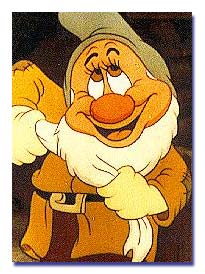
When I think back to my own childhood, I remember the moments of strict gender conformity during Halloween -- I was Snow White one year, and my brother was Prince Charming. (OK, ignoring the odd incestuous implications of that one...let's move on...) My parents, however, were the dwarfs. Even now, this strikes me as so odd! A complete reversal of roles. My parents were obviously taller, yet they dressed as dwarfs. My mom was obviously female, but she donned a gray beard. So, maybe my brother and I were blessed because even in the midst of our moments of ultimate gender conformity, we were shown the freedom to be whatever we wanted to be.
Posted by
Rebecca Lauren
at
5:54 AM
1 comments
Labels: childhood, movies, television, traditions
Wednesday, July 2, 2008
Man and Wife
My partner and I are wedding photographers, which makes it inevitable that I should write about gender disparity in the ultimate bastion of patriarchy in American society: the wedding ceremony.
This weekend, I heard a phrase that I hadn't heard in some time: I now pronounce you man and wife.
It took me back to the memorable scene in the Princess Bride Wedding.
Prince Humperdinck just can't wait for the priest to say those magic words, "man and wife." It will define his marriage to Buttercup. It will seal the deal.
So what's the problem with this time-honored sentence? It assigns men and women different and unequal realms. While it defines a man by his gender, it defines a woman by her role. Consequently, a man merely has to exist, while a wife must fulfill her duty in marriage. He is not required to act as a husband, but she is asked to act as a wife.
This language is important because it tells women that they are responsible for a marriage's success or failure. They are the ones who must serve, while the man is the one who must be served.
And while we're talking about language, the word "patriarchy" comes from the Greek words πατήρ, father, and αρχή, rule. Male authority can take many different forms. In the institution of the family, men have traditionally been given power over women in terms of property and ownership. Until the passage of the Married Women's Property Act of 1848, women relinquished ownership of all property on her wedding day to her husband. Thus, literally and figuratively, her husband "owned" her.
Today, patriarchy in the institution of marriage is less overt. We almost take for granted that children are automatically given their father's last name or that a man is still expected to "bring home the bacon," while a woman is expected to keep house. Still, these gendered expectations certainly affect our most intimate relationships. For instance, if a woman makes more money than her male spouse, should he feel inferior? If a man like
s to cook or clean or do laundry, is he too "feminine"?
In my own home, I find myself falling prey to gender expectations like these. One example: I'm off for the summer, but my partner works. He likes to cook, and I don't. For him, cooking is relaxing, a creative outlet, an opportunity to try something new. For me, it's a chore. So who should cook dinner tonight? Can I remove all patriarchal influences when making that decision? Is the guilt that gnaws at me there because I don't have to work all day or because I feel like I should want to cook as a woman and don't?
It's tough stuff.
I like to look at the ending of the Princess Bride as an optimistic one. Check out the dialogue when Buttercup reveals to Westley that she's married Humperdinck:
Buttercup: Oh, Westley, will you ever forgive me?
Westley: What hideous sin have you committed lately?
Buttercup: I got married. I didn't want to. It all happened so fast.
Westley: It never happened.
Buttercup: What?
Westley: It never happened.
Buttercup: But it did. I was there. This old man said, "Man and wife."
Westley: Did you say, "I do"?
Buttercup: No. We sort of skipped that part.
Westley: Then you're not married. If you didn't say it, you didn't do it.
Ah, the power of language. Westley's right. Saying it is doing it. In my own commitment ceremony, we agreed to be "partners in life." The phrase evoked a kind of agency on both our parts, a commitment to serve each other.
Yet even so, I'm still not convinced that it's my turn to cook tonight. :)
Posted by
Rebecca Lauren
at
1:17 PM
0
comments