Well, the semester has kept me busy and away from blogging, but I can taste summer in the air, so here's to my second blogging wind!
Soooo, as I've mentioned a billion times before, I grew up as a feisty Christian, attending a giant Christian music festival every summer, serving as a Christian camp counselor, running my church youth group....you get the picture.
So when one of the best Christian artists of the early 00's, Jennifer Knapp, left the singing business quite abruptly in 2003, my curiosity was peaked.
For years, Christians have speculated about her departure. Was it family issues? Relationship problems? Was she losing her faith?
But above all, the question that continued to surface was, "Is she a lesbian"?
For those of you who did not grow up singing Kumbayah around the campfire, this seems to be the central concern of the Christian faith. Even worse, perhaps, than atheism is the idea that someone who professed Christianity would come out.
Well, come out she did! Seven years later, in an interview with Christianity Today.
Here's what I love about the article: the interview tries his darndest to get her to deal with her "struggle" in regard to homosexuality. Knapp refuses to acquiesce, instead calling into question the term "struggle" in the first place. She has this amazing ability to graciously allow her faith and her sexuality to co-exist.
She seems happy now -- content -- and authentically herself. And she'll be joining the re-vamped Lilith Fair tour this summer. She's not tortured or suicidal. She's not meek. She's just allowing herself to be who she is.
If only the rest of the Church could do that.
I'll leave you with just a few of my favorite passages that illustrate the honesty of Knapp's beautiful, prophetic spirit:
I'm in no way capable of leading a charge for some kind of activist movement. I'm just a normal human being who's dealing with normal everyday life scenarios. As a Christian, I'm doing that as best as I can. The heartbreaking thing to me is that we're all hopelessly deceived if we don't think that there are people within our churches, within our communities, who want to hold on to the person they love, whatever sex that may be, and hold on to their faith. It's a hard notion. It will be a struggle for those who are in a spot that they have to choose between one or the other. The struggle I've been through—and I don't know if I will ever be fully out of it—is feeling like I have to justify my faith or the decisions that I've made to choose to love who I choose to love.
I've always struggled as a Christian with various forms of external evidence that we are obligated to show that we are Christians. I've found no law that commands me in any way other than to love my neighbor as myself, and that love is the greatest commandment. At a certain point I find myself so handcuffed in my own faith by trying to get it right—to try and look like a Christian, to try to do the things that Christians should do, to be all of these things externally—to fake it until I get myself all handcuffed and tied up in knots as to what I was supposed to be doing there in the first place.
Yeah, Jennifer. Preach it, sister.
Wednesday, April 14, 2010
Former Christian Artist Jennifer Knapp Comes Out
Posted by
Rebecca Lauren
at
5:33 PM
1 comments
Monday, January 4, 2010
Mourning Mary Daly
Sometimes, we are reminded quite suddenly about the importance of life. Often, this realization comes in response to a great loss.
For the last two months, I have been bombarded by the typical demands of life -- running a business, wrapping up one semester, preparing for another, enjoying the hubbub of the holidays. All of these are good and important parts of who I am. But in the meantime, blogging about gender issues continued to take a back seat to these other responsibilities.
Then, this morning, I opened an email from one of my feminist listserves to discover that feminist theologian Mary Daly had passed away yesterday after two years of struggling with ailing health. Daly was one of those writers whom I felt I knew intimately; like if we had a chance meeting at a local coffee shop, we'd chat for hours over cups of chai. I feel like she cultivated this intimacy with many of her readers, and I believe it's largely because of the incredibly honest way that she explored her theological journey.
If you've never read her work, I recommend reading it chronologically. Start with The Church and the Second Sex, a text that seems woefully outdated to most contemporary feminist theologians, but is vital in understanding the groundwork laid by pioneers in religious feminist thought. In it, Daly is so seemingly innocent about her questions about theology and ecclesiastical hierarchy -- Why are all the priests men? Is the Virgin Mary an empowering figure to women or a limiting one? Why are women and men told that they have equal access to salvation, but then, according to the Catholic church, women have to get theirs through submission to men?
Then, as you progress through her later works, prepare to have your socks knocked off.
Move on to one of her most well-known works Beyond God the Father, where she questions the patriarchal nature of God. From there, perhaps indulge in the poetry of a new theology created in Gyn/Ecology or, one of my personal favorites, her witty dictionary of new feminist theological terms in Wickedary.
Daly is playful, subversive, and poetic. When I first encountered her writing, I did not know what to do with her. In fact, if you ascribe to traditional religious beliefs, her later works will probably make you uncomfortable. And rather fidgety. For me, they were kind of like the itch I couldn't scratch. For others, they generate anger and resistance. Here's why.
Daly begins her theological journey by trying to find ways to work within the traditional church, but she quickly determines that religious practices are too mired in the patriarchal nature of God (with a capital "G") for God's true egalitarian nature to be redeemed in any meaningful way for women. And while her spiritual journey and mine digress at this point (she rejects a patriarchal God; I try to rework my understandings of God so that they are non-patriarchal), I appreciate that her anger is honest and her questioning is real. I have encountered very few theologians who have achieved this level of prophetic bravery combined with an innovative intellectual pursuit of theology.
Daly has allowed me to analyze the patriarchal aspects of my belief systems, which in turn allowed me to reject those aspects that are harmful and uncover those aspects that are empowering to women and offer voice to the voiceless. I admire Daly and seek to emulate her unabashed desire for wholeness, community, and real love.
So today I honor Mary Daly's life, not, as is typical after someone's passing, because of fond memories or good deeds (both of which I'm sure exist in excess) but because of her rich intellectual life. Daly has reminded me, once again, at how powerful intellectual inquiry can be, how it can change lives through a never-before-articulated question, a well-worded rebuttal against the status quo, or, in Daly's case, an entirely new vocabulary to mirror an entirely new way of thinking.
The next time I put blogging or research on the backburner of my life, I'll think of Daly. She has taught me in earnest that the mind is a terrible thing to waste.
From Mary Hunt, in her brief memorial to Daly from Feminist Studies in Religion:
She created intellectual space; she set the bar high. Even those who disagreed with her are in her debt for the challenges she offered.
May we all strive for such a rich legacy of ideas.
Posted by
Rebecca Lauren
at
11:48 AM
5
comments
Labels: arts, language, literature, religion, traditions
Friday, July 31, 2009
Hollywood keeps career women trapped in rigid stereotypes
I'll be the first to admit that I'm pretty pop culturally unaware. In fact, one of my partner's favorite party tricks is to name a slew of recent movies and ask how many I've seen. The answer is almost always none.
Perhaps my general ennui with Hollywood films is a subconscious (or not-so-subconscious) response to their portrayal of women. Now, I'm not going to rant about what you might expect -- women portrayed as sex objects, marriage-obsessed individuals, weaklings, or morons -- although there is plenty of that happening too. I'm not even going to point out how few women possess lead roles in major blockbuster films. (By the way, there's a great blog on all these issues, if you're a little more pop-culture or film savvy than I am.)
Instead, I today take issue with how career women are often portrayed as what NPR pop culture critic John Powers refers to as "bossy, uptight and utterly without personal lives. What they need, we're supposed to think, is a man. But before they can get one, they must have a mortifying comeuppance."
His story, "On Hollywood's Strong, Self-Hating Women," is a fantastic and balanced insight into yet another one of those gendered stereotypes that we as Americans have seemed to internalize without a second thought -- namely that career women are emotionless individuals who need to realize how much they need a man.
Powers' article offers several examples of films (again, none of which I've seen) in which Hollywood seems to unleash "dark, paranoid fantasies about unwomanly women and pushy shrews. It served up a parade of Prada-wearing devils." Powers attributes this oddly consistent image of women to a backlash against the feminist movement, fueled largely by a target audience of insecure adolescent men.
While it's great that professional women are becoming more common on the big screen, we need to get better at portraying them more realistically.
THE UGLY TRUTH trailer in HD
Sunday, April 19, 2009
Why we love Susan Boyle (from a feminist perspective)
If you've seen this video posted on everyone's Facebook page, tweeted about on Twitter, and watched thousands of times on Youtube but just assumed it was another American Idolesque fad, you couldn't be more wrong.
I've now viewed it four times, and each time, I burst into tears. I thought it was just me, but then I showed my rather stoic partner, Joe, and he, too, burst into tears. In fact, he promptly watched it through a second time and then pulled out our Les Mis soundtrack and declared that Susan Boyle's version was better.
So what is it that gets us about this woman? I mean, the whole world seems incredibly moved and affected by Boyle's performance.
While Simon Cowell and the other judges touched on it a bit, I think they need the aid of a gender lens to truly understand what all the hype is about. It's not just that Boyle appeared frumpy, nervous, and goofy before pulling off a sincerely moving performance; it's that she defies our expectations of an acceptable female singer. Namely, she's shown that good looks are not a requisite for the presence of a good voice.I would venture to say that most of the audience -- me included -- assumed that an older gray-haired woman with bushy eyebrows, dressed in a faded housedress, could not have a decent voice. I don't think we hold men to nearly the same standards. (Consider, for instance, gray-haired Taylor Hicks or overweight Ruben Studdard, both American Idol winners.)
In fact, we frequently offer disdain to female performers who do not match our society's stereotypes in terms of female beauty and body image. Think of Queen Latifah, once celebrated for her curvaceous vivaciousness, now spokeswoman for Jenny Craig. Marie Osmond is spokeswoman for Nutrisystem, and Wynonna Judd is the celebrity representative for Alli, a weight-loss drug. Over and over again, the message seems to be that female performers are not acceptable if they are not skinny, wrinkle free, and flawless.
Susan Boyle defies that image, and she does so with a lovable quirkiness and confidence. And now that record companies are knocking at her door, my only prayer is that she does not give in to the pressure to conform. I want her to grace her first album cover, wrinkles and all, with her gray hair wisping in every direction and her housedress clinging to her sides. I want this woman to continue to show us that look aren't everything and that regardless of what society tells us, we can dream any dream we darn well please.
Posted by
Rebecca Lauren
at
2:45 PM
4
comments
Labels: arts, body image, fashion, media, television, weight loss
Saturday, March 7, 2009
Gender as portrayed in Norman Rockwell's paintings
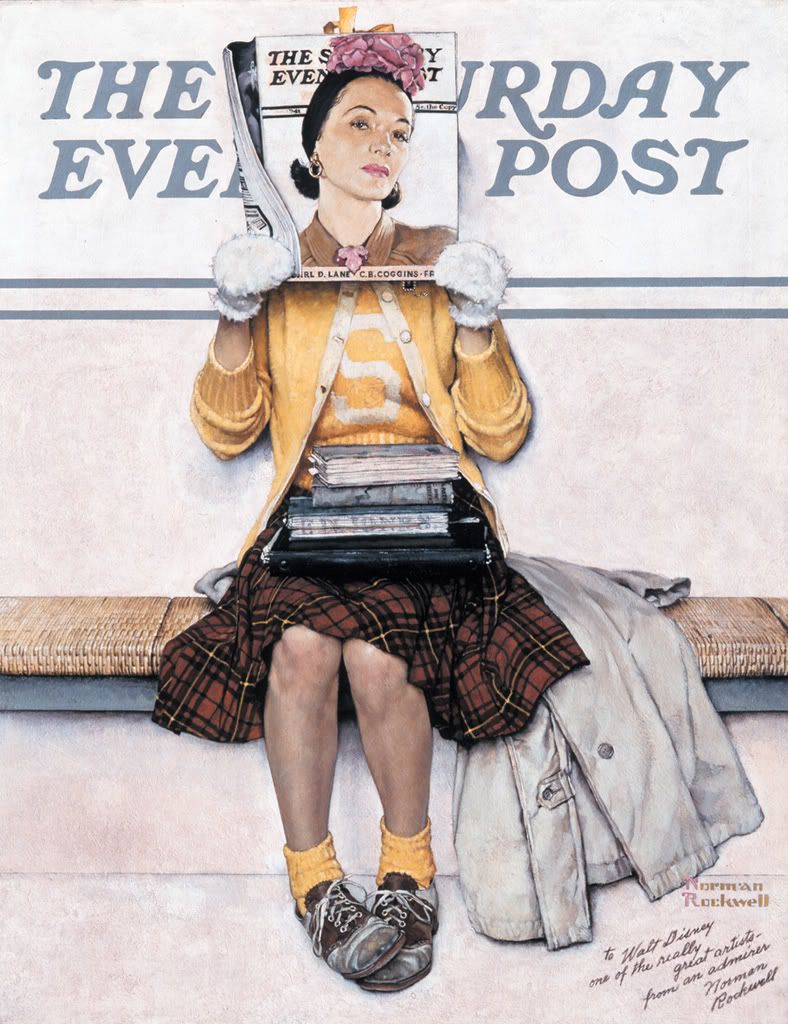
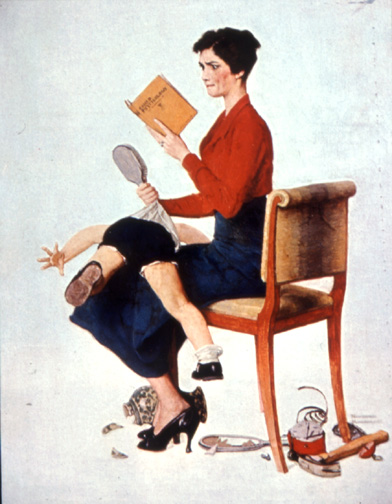
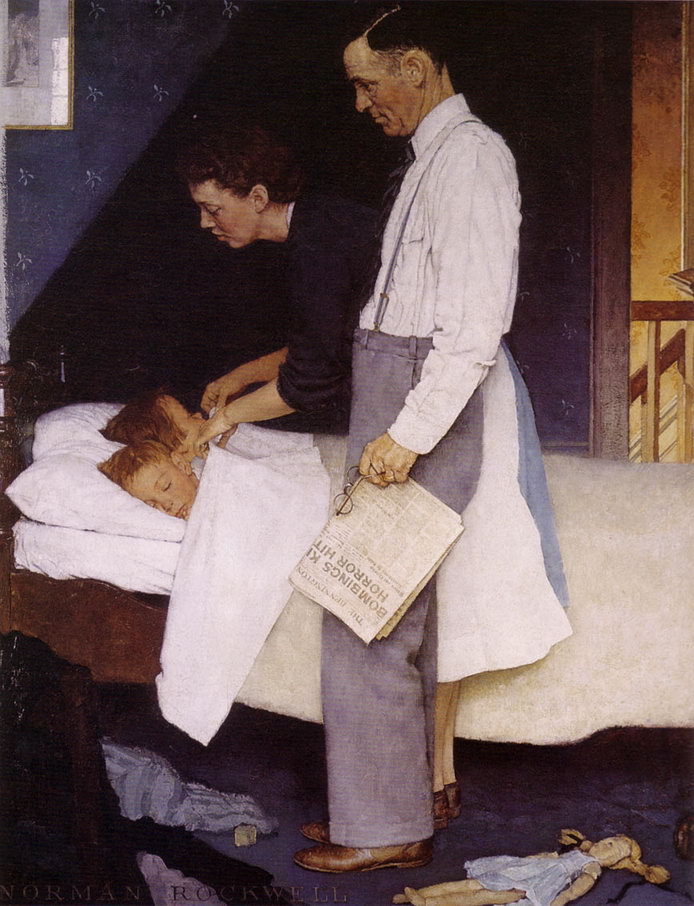
While in Vermont, one of our pursuits was the Normal Rockwell Museum. I grew up with these images in heavy wooden frames all around our house and was excited to take a closer look at some of his lesser-known paintings. I'd been to the museum a few years ago, but what interested me this time was Rockwell's portrayal of women. I was not disappointed.
However, something changes at adolescence. The girls in his illustrations seem to receive a different message altogether. Note the progression here:
And while there are some surprising moments of seeming gender equality, what follows is a clear definition of separate spheres for men and women. Rockwell's adult subjects clearly do not have the freedom to transgress their gender roles as much as the children did.
Then again, Rockwell did somewhat redeem himself with Rosie the Riveter, modeled after a local telephone operator:
All in all, Rockwell offers a fascinating window into the construction and later transgression of gender roles in this country.
Posted by
Rebecca Lauren
at
2:22 PM
2
comments
Labels: arts, body image, childhood, history
Sunday, February 22, 2009
Oscars? Yup, still a boys' club.
The fact that the award itself is named after a man should tell us something, but many of us will still crowd in front of our television sets this evening and tell ourselves that this is a fair, unbiased representation of the best acting/directing/producing/artistic talent in the movie world.
However, when we polish our lil gender lenses, we'll find that this just is not the case.
Consider, for instance, what Melissa Silverstein of the Huffington Post points out (and this is just a sample):
-None of the Best Films Feature a Woman as the Lead
-Directing is Still a Boy's Club
-Women of Color Dominate the Supporting Actress Category Congrats to Viola Davis (Doubt), Penelope Cruz (Vicky Cristina Barcelona), Taraji P. Henson (The Curious Case of Benjamin Button). The best actress category is white and not a single of the male acting nominees are of color.
-A Woman Still Has Never Been Nominated for Best Cinematography
Hesse also points out that "the only categories in which women have more nominees than men are Best Actress and Best Supporting Actress."
I also have to recommend Monica Hesse's piece in the Washington Post, which asks, among other things, why we have a gendered Best Actor / Best Actress category in the first place. She also quotes the following 2008 study from the University of Southern California:
The study evaluated nearly 7,000 speaking roles in recent Oscar-nominated movies, finding that only 27 percent of those roles belonged to women. In films with female directors, however, the percentage jumped to 44 percent.
As I'm munching on popcorn and soft pretzels with friends, I'll be pondering the gender inequity of tonight's events while cheering on my favorite nominees. It's tough to do both at the same time, I admit. But alas, this is the plight of a feminist movie fan, is it not?
Posted by
Rebecca Lauren
at
2:28 PM
0
comments
Labels: arts, media, movies, television
A little "Changeling" needed for gender roles
Last night, my partner and I finally got a chance to watch The Changeling, directed by Clint Eastwood and starring Angelina Jolie. I'd been anticipating this movie since it's release months ago, and now that it's out on DVD, my expectations had grown to gargantuan proportions.
And I can't say I was disappointed. My partner, Joe, actually cried at this film, and anytime Joe cries at a movie, it gets two thumbs up from me. (My tear ducts are a bit less reliable, as anyone remotely familiar with my gene pool will tell you.)
The plot followed real events in 1928 when a boy, Walter Collins, was reported missing by his mother, Christine Collins. Five months later, the police presented Christine with a boy who claimed to be Walter, but was not in fact her son. Despite her protests to the contrary, the police refused to believe her stories and went as far as having her committed to a psychiatric ward against her will.
To me, the film's greatest triumph was it's ability to portray the cultural creation of hysteria in women. The word hysteria comes from the Greek hysterikos, which means "of the womb" or "suffering in the womb" (think of the English term, also derived from the Greek, "hysterectomy").
Hysteria became used as a catch-all diagnosis for "womanly diseases," especially those involving faintness, nervousness, sexual dissatisfaction or really any attempt by a woman to subvert the status quo. Particularly prevalent in the Victorian era, hysteria was frequently used as an excuse to institutionalize women who refused to ascribe to their place in society.
In laywoman's terms, it was what they labeled wild ass women in order to get them under control. And control is really what this movie is about. Almost all of those in power are men -- the police officers, the head doctor at the psych ward, and even the pastor who befriends Christine, yet controls her story for his own purposes.
Perhaps the only time in the movie when we find solace in female redemption from patriarchal control is in the psychiatric ward, when Christine meets another female patient, Carol Dexter, played by Amy Ryan (who plays Beadie in The Wire, one of my favorites). Carol explains to Christine that all her control has been taken away from her. If she asks to speak to the doctor in charge, she will be assumed to be unable to deal with authority. If she becomes silent, she is diagnosed as withdrawn. If she claims her innocence, she is seen as delusional. In short, she is trapped.
And while many women do not end up in a psychiatric ward, many certainly feel trapped by patriarchal forces, unable to find our voice or make ourselves be heard.
There are a lot of disturbing and haunting moments in this film, but what haunted me the most were the number of times that Christine, in all her unbearable grief and frustration, smiles -- actually smiles -- at the men in charge. It's as if she realizes that she's tried everything else, and nothing works. They won't listen to her directly, so she has to charm them instead. It's eerie.
So tonight, I'll be rooting for this film as I watch the Oscars. (See my next post for reasons why my cheering won't be quite as loud in other categories...)
Posted by
Rebecca Lauren
at
12:47 PM
0
comments
Labels: arts, history, media, mental illness, movies
Tuesday, January 27, 2009
Top Chef? Or Top Chauvenist?
Add in a pinch of sexism and a dab of meritocracy, and what do you get? An interesting impromptu Facebook conversation about Bravo's hit reality TV show, Top Chef.
A little background info: Stefan is one of the remaining contenders. He seems to be a good cook, but he's quite full of himself, and no one wants to work with him because his attitude is horrible. I've been rooting against him just about every episode, but last week, when the freezer broke and he was supposed to make a frozen dessert, I marveled at the fact that he figured out a way to make it work. I thought this was innovation. My friend, CR, however, thought this was a sure marker of privilege.
Here are bits of our conversation (admittedly rushed, off-the-cuff, and written in haste as we both tried to avoid grading papers)...
CR:I wouldn't care if Stefan managed to freeze that dessert by holding individual ice cubes up to it for 4 hours straight. Ugh. Ugh. I happen to think a lot of that "find a way to make it work" mentality is all about growing up with privileges that lead you to believe that you can do and be anything you want. I think that is why we see it much more often in men than women. I don't know Stephan's background (beyond being white and male), but I'd be willing to bet that he is middle class or upper class. Put all those things together and the world is much less likely to tell you that you can't do things.
RL: Fascinating insight, but I could argue the complete opposite. I mean, doesn't growing up with little mean that you have to be innovative to make the best of it? Some of the best recipes come when there is nothing in the house, and you have to figure out what to do with what is left. So, having less means that you are forced to be more creative. You say that being a WASP means that "the world is much less likely to tell you that you can't do things," but doesn't that mean that you also never have anyone challenging you? If people always like what you have to offer, then where is the motivation to get better? And you have to admit, Stefan is a decent chef. I just hate his attitude. I mean, the show isn't judging him on whether or not he's a selfish pig. They're judging him on how he cooks. And the man can cook.
CR: I do agree that he seems to be a good chef. I will also say, though, that the show has a history of what I see as sexism and classism. It seems very much like the judges have an idea of who they think deserves to win from the very beginning. Then there were the comments at the end of last season when the win of a woman (the first one to get so close!) who consistently made really good food was downplayed because "it was Richard's to lose" rather than hers to win. I don't know, but that spoke volumes to me. Her food was good; she proved it over and over again, yet it wasn't hers to win but someone else's to lose. Someone else who also made good food but far less consistently. Of course, the show is scripted to a certain degree, and choices are no doubt influenced by producers who are trying to keep the drama going. I guess what I'm getting at here is that I think Stefan has an advantage -- one that does not rest on merit.
And I see what you are saying about having to be creative, but that's really different than what happens on the show. Making a meal for 5 with nothing but rice, a can of pickled beets, and processed cheese is one thing. It requires invention and creativity, but historically I don't think that kind of creativity has been nearly as heralded as, say, making some kind of gourmet food with all sorts of unlimited resources.
I also see *having* to be creative as different than growing up with a feeling that you can do anything. If you are doing miraculous things in the kitchen with $30 worth of groceries every week you are still very likely being beaten down in a variety of ways. The overwhelming message is that you aren't as worthy or good as the next person. In the end, I'm not so sure that it would matter about those $30 worth of groceries and what you could do with them.
RL: Sensei, you are very wise. Very wise indeed. I completely agree with you about the sexism at the end of last season. And I think that Stefan certainly has had advantages that, say, Gene [Hawaiian contestant who worked his way up from a dishwasher to a chef], did not, and that's definitely a class thing.
But the problem with any meritocracy is that it's nearly impossible to simply measure pure merit. We are always measuring class as well. For instance, I'm thinking about kids in elementary school as they're learning to read. The teacher is measuring their "ability" to read, but he/she is also subconsciously measuring how much time the child's parents spent reading with him/her outside of school. Often, in working class households, there isn't much available reading time. So what is the teacher really measuring? What class you were born into?
I guess what I'm saying is that to enjoy a show like Top Chef, I as the viewer have to pretend that it's all about merit. I'm sorry that Gene spent years washing dishes instead of being exposed to the culinary possibilities that Stefan was likely exposed to, but there's no way to even the playing field after the fact. It's not like we can say, "Hey Stefan, stop cooking for a few years so Gene can catch up." I have to judge them on the food they put on the table. And Stefan seems to cook good food.
CR: I completely agree with you about there being no such thing as pure merit, and your example is a perfect one. Where we seem to differ is the ability to do the kind of pretending you described. I can't watch the show without seeing it. I think that is probably what makes you the more optimistic one and makes me the grumpier one. I honestly see positive things in both approaches.
In order for me to not throw myself into moving traffic I have to believe that acknowledging it does make a difference and while I agree that it is difficult to figure out how to level the playing field, I think it is vitally important that we try. And I'm not saying that you don't believe that because I think you do. I'm just saying that for me not to see those things makes me feel (more) complicit.
RL: I know what you mean about not being about to ignore the sexism and classism when trying to watch the show. In fact, it drives my partner nuts because we'll be watching TV and he'll say, "I really like this commercial," and I'll go off on a rant about all the ridiculous oppression happening all over the place. Poor thing is usually like, "Oh. I didn't see that."
But I guess my point in "pretending" was that there's no way in the competition itself to level the playing field. The groundwork has already been laid (eek, lain?), and there's not much to do but sit back and laugh at the spectacle. And Stefan certainly is a spectacle.
But you're also right in saying that when we stop noticing, we become complacent, so I'm always glad for you noticing these things because they remind me to notice.
Posted by
Rebecca Lauren
at
5:32 PM
1 comments
Labels: arts, class, television
Tuesday, November 4, 2008
The West Wing and art as prophecy
Several years ago, the brilliant writers of the TV show The West Wing envisioned a relatively unknown Congressman's rise to the presidency. A Congressman of color.
At the time, it seemed mere fiction. We all knew that only white men who were entrenched in the political system were eligible for the presidency, or at least it seemed that way.
But The West Wing artists must have known that things could be different. They dared to create a picture of a different future.
My partner and I have been noting the distinct similarities between the West Wing seasons and the current election, and Brian Stelter of the NY Times just articulated them in a brilliant article this week:
"When Eli Attie, a writer for “The West Wing,” prepared to plot some episodes about a young Democratic congressman’s unlikely presidential bid, he picked up the phone and called David Axelrod...
Days after Mr. Obama, then an Illinois state senator, delivered an address to the 2004 Democratic National Convention, the two men [Attie and Axelrod] held several long conversations about his refusal to be defined by his race and his aspirations to bridge the partisan divide. Mr. Axelrod was then working on Mr. Obama’s campaign for the United States Senate; he is now Mr. Obama’a chief strategist.
Four years later, the writers of “The West Wing” are watching in amazement as the election plays out. The parallels between the final two seasons of the series (it ended its run on NBC in May 2006) and the current political season are unmistakable. Fiction has, once again, foreshadowed reality."
Consider this clip from The West Wing where Matt Santos begins his run for the presidency. Sound familiar?
If you're a West Wing fan, then these similarities might further confirm your suspicions that The West Wing is the best show to ever hit television. But I think this scenario teaches us a lot more than that.
As I sit here at my laptop with CNN computing exist polls in the background, I'm realizing that the visions of the West Wing's creative staff members are becoming reality. Not that I'm giving The West Wing sole credit for Obama's projected win in this election, but I do believe that in order to create a reality, we first have to be able to imagine that it could be so.
The West Wing did that for us as a nation. For the years that it was on TV, I heard people say things like, "Man, I wish Martin Sheen or Jimmy Smits could run for President." The truth is, we didn't want Martin Sheen the actor to run for office; we just wanted someone who wasn't afraid of their own humanity (think President Bartlet's MS), someone who knew a little bit about real life (think Jimmy Smits' character and his desire to send his kids to a public school), someone who talked about justice and meant it (think the entire West Wing staff).
We wanted the possibility of the dream becoming a reality.
As a poet, people often ask me why I write. It certainly doesn't earn me any money or fame. It doesn't carry with it any tangible results. In fact, most times, I write without knowing if anyone will ever read it.
It's times like these that make me remember why we continue to persist as artists -- because it's about creating a vision. I write because I want to make sense of my world and imagine new ways of being within it.
Shows like The West Wing did that for us as a nation.
As we watch tonight as our first African American president takes office, let's remember that it all starts with a vision. It should make us ask, "What can we conceptualize for women? How can we imagine new realities for our gender?" We begin with a small figment of our imagination that, with a little culling, becomes a reality. This is our path to equality.
Posted by
Rebecca Lauren
at
6:26 PM
1 comments
Labels: arts, politics, television
Sunday, September 28, 2008
A shout out to my wonderfully unconventional youth group
Generally, when I hear the words "youth group," what comes to mind is lots of Kumbayaa-ing around a fire pit, a series of nonsensical group games involving whipped cream and paper bags, and a lesson that inevitably leads us all to repent of our weekly failings and draw closer to God.
So when my church asked Joe and I if we'd be youth group leaders, I had to seriously pause.
My parents were my youth group leaders when I was growing up, and they were always full of energy and earnest about their roles.
But in this era of postfeminist thinking, I had to re-evaluate what my approach youth group might look like. I decided that I'm anti-indoctrination, anti-God-as-father-but-not-as-mother, anti-religion-as-excuse-to-sit-back-and-wait-for-heaven, etc. You get the picture. So what's a feminist youth group leader to do?
Fortunately, I'd found this superbly crazy church family at Central Baptist Church, so I had nothing to worry about. (Don't let the Baptist fool you -- these guys and gals are into social justice, changing the world, serving the poor, welcoming the LGBT community, etc.)
At this weekend's annual youth retreat, we had the requisite group games and singing, but we also journaled, played with modeling clay, made up rhythmic chants as prayers, and painted.
My favorite activity this weekend came when one of the leaders asked the youth to create a craft project that reminded them of God. One kid drew an awesome picture of a muscular guy with tattoos. "I think God sits on a big couch up there with a high-def TV, making sure we're all doing alright," he said.
When someone asked him about God's tattoos, this kid said matter-of-factly, "Oh, isn't it obvious? God's been in the Navy."
I cracked up.
Then, another youth member said that God, to her, was a woman.
The kid sitting next to me read me his "Letter to God." It said:
God, please watch over us. You are a light saber. May the force be with you.Another made a banner out of purple glitter that said "God is da bomb."
Unconventional? You bet. But what's wonderful about these youth is that they view God as this great creative being, as one who lives beyond rigid gender roles and can be man, woman, light saber and purple glitter all at the same time.
In short, I love each and every one of these youth for their quirky creativity. I love that they are all reflections of a God that I can believe in -- one who is full of love, joy, and endless, genderless possibilities.
Thursday, July 24, 2008
"thoughtful, bemused, affectionate, deeply skeptical outsider"
These six words are what Dana Gioia, chairman of the National Endowment for the Arts, used to describe the new poet laureate of the United States, Kay Ryan.
Hooray, Kay! As one of only a handful of women chosen for the position since its founding in 1937 (then called Consultant in Poetry to the Library of Congress), Kay Ryan is a deserving choice. In addition, she's the only "out" gay individual ever chosen. This decision illustrates great strides in the literary establishment, but we still have a long way to go.
Many people assume that the arts community, because of its liberal tendencies, is largely resistant to the influence of patriarchy. As a female poet, I observe on a regular basis that this is not necessarily the case.
Consider the following statistics distributed at this year's AWP panel, entitled Women's Presses, Activism, & Gender Inequities in the Literary World:
1. In the history of the National Book Awards, only 29 percent of the winners have been women.
2. The New York Times Book Review from Dec 9 listed the 10 Best Books of 2007: 5 fiction titles by men; 5 non-fiction, only two of them by women.
3. A full-page ad celebrating 2006 National Poetry Month, sponsored by the Academy of American Poets and listing more than 100 institutional sponsors, prominently features excerpts of five famous poems--none of which were written by a woman. The official poster for National Poetry Month 2006 includes eighteen such quotes--no more than 25% by women poets.
4. Of the 137 authors in the most recent Norton Anthology of American Literature, less than one-third are women.
5. In early 2005, women constituted only 17% of the opinion writers at The New York Times, 10% at The Washington Post, 28% at US News & World Report, and 13% at both Newsweek and Time.
6. In 2003, only 28% of all books reviewed in the New York Times Book Review were written by women.
7. In 1995, 40 feminist presses existed in the U.S. and 40 in the rest of the world; there are now roughly six.
Consider, also, that since the founding of the original poet laureate post in England in 1668, no woman has yet to be chosen.
There are plenty of female writers out there, just waiting to be found. This feeling of invisibility is perhaps best captured by one of Ryan's own poems:
Hide and Seek
Kay Ryan
It’s hard not
to jump out
instead of
waiting to be
found. It’s
hard to be
alone so long
and then hear
someone come
around. It’s
like some form
of skin’s developed
in the air
that, rather
than have torn,
you tear.
Posted by
Rebecca Lauren
at
5:48 AM
0
comments
Labels: arts, literature, poetry