Showing posts with label childhood. Show all posts

Wednesday, November 4, 2009

Why I refuse to explain my love of baseball to the obnoxious fan at this week's World Series game

Perhaps you've grown used to Gender Lens' intelligent analysis of those important political or media-related issues that influence women and men today. Perhaps you look forward to my twice-monthly posts and their well-considered approaches to gender.

Well, this is not one of those posts. This, my friends, is a rant. Plain and simple.

It began this Christmas, when my dad purchased a pack of partial season tickets for our family to share. This meant that several times this year, my brother and his partner and me and my partner were able to cheer on our favorite team -- the Philadelphia Phillies.

I'd like to note that my dad did not simply buy tickets for himself, my brother, and my husband. This is because my dad understands, and has always understood, that baseball is a sport loved by both men and women. Dad coaches high school ball, and ever since I was in the crib, I had a baseball in my hand.

Until I was 13, I played baseball on a team with all boys. I spent a lot of my time trying to prove myself worthy. One of my fondest memories was during a particular game when the entire infield and outfield moved in about ten steps as soon as they saw that I was a girl up to bat. I got my favorite type of pitch -- low and across the plate -- and I wailed it over all of their heads. Vindication was mine.

Unfortunately, these moments were few and far between, and I found myself constantly trying to be more like the boys and prove myself as such instead of just enjoying the game. I switched to softball in high school, but I remain an avid baseball fan.

So as you can imagine, when my dad told my partner and I that we had tickets to Game 3 of this year's World Series, we were beside ourselves with excitement. Not only was this a World Series game; this was MY TEAM in the World Series. I'm not exaggerating when I say that for this lifelong baseball fan, it was a dream come true.

It would have been even more of a dream come true if it were not for two things:
1. We lost.
2. I sat next to this most obnoxious and intolerant fan in the history of baseball.

The guy sitting next to me not only claimed the armrest for the duration of the game, sticking his pointy elbow in my face every other second, but he also managed to offend Native Americans, Japanese people, and Mexicans in a very short amount of time. He'd shout completely offensive things over and over again, including chides to the Phillies pitcher to "Hit the batter right in the face! Just smash his entire face up!"

Finally, one of the women sitting in front of us turned around and said, "Wow, you have quite a bellowing voice!"

I thought this was a rather polite way of telling the fool to shut his intolerant mouth, but he obviously disagreed.

He said, "Listen, lady. I'm not going to apologize for cheering at a baseball game. That's what I came here to do. Some of us have actually been here all season. We didn't just buy a World Series ticket."

The woman turned to him and said, "I've been here all season too."

What disgusted me about this exchange was the fact that the guy assumed that because the individual was female, she certainly couldn't be a REAL Phillies fan.

When I whispered a summary of this exchange to my partner, he said, "I don't think he meant anything gender-related by his comment."

I responded that he (my partner) had never been to a sporting event as a woman. Meanwhile, I've spent the better part of my life trying to justify my interest in sports to men and trying to prove to them that I am a real fan.

Just last week in one of my classes, the students were talking about a great football play from the week before. Interested, I asked them what had happened, and one of the male students responded, "You wouldn't understand. It's a guy thing."

I took him to task for that comment and gave a short lecture on sexist language. I'm not sure it did very much though.

The effect that this kind of attitude has on women, particularly young girls, is that it encourages them to get involved in only certain gender-approved realms of life -- cooking, talking on the phone, shopping. Thankfully, I believe that the current generation of girls is beginning to change this paradigm. With the passage of Title IX, more and more girls are participating in sports than ever before.

Still, our culture needs to change its overall attitude towards girls and sports. We need to take down the "No Girls Allowed" signs when we consider who is and who isn't a real fan.

I don't have an inspirational remark with which to end this rant. All I have to say is this: Tonight, oh blogosphere, as I root on my dear Phillies, I will not be explaining to ANYONE why I love baseball and why I deserve to be counted as a real Phillies fan.

Go Phils.

Friday, October 30, 2009

Halloween makes it too easy for us gender bloggers

If we were ever uncertain about the prevalence of strict gender roles in our country, Halloween is always there to remind us. Last year, I explored the ridiculously limited array of costumes for boys and girls. Visit any costume website, and you'll likely see princesses and ballerinas for girls, ninjas and superheroes for boys.

These stereotypes affect us all because they condition us to embrace certain characteristics and resist others, depending on our gender.

A friend posted this video on Facebook today. It's from the Onion, and is obviously meant to be a spoof on shows like Good Morning America. The topic is how to come up with masculine costumes for decidedly effeminate boys.


It's a funny video, but with any humorous spoof, there's an ounce of truth in its depiction. It has a sense of speaking the unspoken, of revealing a perspective that many parents subconsciously ascribe to, but are afraid to admit to out loud -- the desire to keep boys from becoming effeminate.

It's interesting because in this era of girls' soccer and girls' rising performance in traditionally masculine subjects like math, we don't seem to be as afraid of girls becoming more like boys.

I think that this is because our culture is afraid of the feminine. Unlike masculinity, femininity indicates weakness and emotionality. I have seen countless parents do everything possible to keep their sons from being interested in dolls. Just watch any rerun of Jon and Kate Plus Eight, particularly in the early years, and you'll see tiny and not-so-tiny gestures that remind the boys that they are not interested in anything pink or frilly or motherly.

Again, we're right back to where Simone de Beauvoir was in The Second Sex -- everything masculine is elevated and praised; everything feminine is deemed second rate. This is largely because the feminine is only defined in relation to the "normal" male sex. Femininity is an aberration.

If only we lived in a world where boys and girls were encouraged to choose from the smorgasbord of human characteristics at will. Maybe we would see effeminate vampires and prancing robots. Maybe we'd also see female superheroes or peace-loving ninjas. The possibilities for Halloween and otherwise are endless.

Saturday, September 19, 2009

Defining gender

I ended my last post by talking about the gray areas of life, particularly when we realize that the clear black and white categories that we've set up do not always work.

Several news stories within the last week have brought to light the very gray area of gender itself.

First, a brief review of definitions:

Sex= The physical make-up of a person that generally gets "male" or "female" stamped on their birth certificate. Sex characteristics include genitalia, one's ability to bear children, and the presence of hormones like testosterone or estrogen.

Gender= A person's sense of themselves as male or female.

As I mentioned in my previous post about tennis star Sarah Gronert, many individuals feel that their gender is different from their sex. (A great explanation of the resulting "transgender" label can be found here.)

Well, last week, another athlete's genitals were subjected to scrutiny, but this time with allegations that the athlete herself was not fully informed about the test's intent. 18-year-old Caster Semenya has spent much of her life fending off comments about her masculine nature. Now, the media has outed her as a hermaphrodite, someone carrying both male and female physical traits. In this case, her sex does not fit into our tidy categories, despite the fact that in her mind, her gender was always pretty clear. For a beautiful explanation of the term "hermaphrodite" and "intersexed," I highly recommend Hida Viloria's first person reflection on this story.

Also in last week's news, a 12-year-old boy in England returned to his school as a girl after summer vacation. The school held an emergency assembly to inform students of the change but were criticized for offering "too little too late" in terms of preparation. As a result of not adequately readying teachers, peer groups, and family members to accept this change more fluidly, bullying and intolerance occurred.

These two examples seem so parallel in that both reflect our insistence on neat, mutually-exclusive categories when it comes to gender. When people don't fit these tidy classifications, we criticize them as being "other" instead of rethinking our categories.

Thursday, March 19, 2009

Happy birthday, Barbie.

Hard to believe, but she's 50 today. Thank God for botox...er...plastic, right?

So I could talk in this post about how harmful Barbie has been to women's body image for the last half century, but if you really think that nippleless size 38 boobs are a normal physicality to ascribe to, you've got problems...problems that this blog post isn't going to solve.

I could talk about how Mattel actually altered these unrealistic proportions in 1997 after so many complaints, but Bitch editor Lisa Jervis did it so much better in a Mother Jones' blog.

Instead, I offer two possibly fresh Barbie insights:

1. If you haven't already done so, buy the book Kinky by Denise Duhamel. It's still the funniest book of poetry I've ever read. Makes you see Barbie in a whole new light.

2. On another note, consider the ways that Barbie has instilled upon our culture the ideal of Caucasian beauty (yes, despite the later "ethnic" Barbies). What happens when we equate "beauty" with "whiteness?" The video below poses a very scary answer. Note, particularly, the study with the dolls...

Thursday, March 12, 2009

The Disney fairy tale wedding fantasy continues

First, a disclaimer: I am really a huge Disney fan. I grew up with all the classics, visited the theme park (even as an adult), and I still have my old Winnie the Pooh stuffed animal who is at least 2 decades old.

And while I'm thankful to Disney for teaching me that even roly poly bears like Pooh deserve to be loved for their fluff and stuff, and that, in the end, good usually triumphs over evil, I'm pretty mad at Disney for messing up my perceptions of love.

It took me a long time to recognize that despite my tomboy nature and my sense of independence, I too had fallen victim to the fantasy of the Disney fairy tale princess mentality. For most of my teenage and college years, I assumed that marriage would make me happy. I wore dresses to proms, dreamed of big diamond engagement rings, and planned out the perfect wedding in my mind.

And get this: I actually owned a wedding journal when I was all of 17 years old. You may be wondering, what in the hundred acre woods is a wedding journal? Well, I'll tell you. It's a place where you write down all of your wedding plans, like the following (which were actually part of said journal):

-Buy a dress with lots of tulle (which now makes me say "GOOD GOD, WHAT WAS I THINKING?")

-Give my husband the letter I wrote to him when I was 17. (I had written this letter to my future husband, whomever that might be. It was the cool thing to do as a Christian girl who wasn't allowed to have premarital sex. You were supposed to channel that energy to the imaginary man with whom you'd one day have sex and envision all the things that he would be. I've since wished that I could find this elusive letter to see all the ways that Joe DOESN'T meet my 17-year-old requirements... which is, of course, a very, very good thing.)

-Release butterflies at the end of the ceremony. (Little did I realize that to do this, the butterflies have to be shipped overnight, and some inevitably die in transit. Then, every guest gets a little box to open at the big "release" moment. After learning all of this, I had nightmares about my flower girl excitedly opening her box to a dead butterfly and spending the entire reception in tears.)

So the problem with all of these obsessive wedding-planning practices is that they perpetuate the Disney fairy tale myth, namely that marriage makes all stories end happily ever after. As most committed, monogamous couples know, the moment you pledge to stay together "as long as you both shall live" is the moment when things actually begin to get hard...really hard. And ten years later? Things get harder.

In short, Disney LIED!

Yet many heterosexual women rush into marriage, buoyed by the hope of eternal bliss that Disney so carefully portrays in Cinderella, Snow White, and Sleeping Beauty (the triad of princess classics). In addition, many women choose to stay in relationships that have long gone sour (or worse, that have turned abusive) because they cling to the idea that their marriage should be happy and their princess lifestyle should last and last.

So should it surprise us that beginning in 2007, Disney unveiled its line of princess-inspired wedding gowns? Here's what they have to say about every girl's socially constructed "dream":

The Gown, The Slipper, The Kiss and The Prince. Under it all, every girl believes in the dream. So here is our tribute to fairy tale wishes and finding true love.

Guess it's time to get out those wedding journals, ladies. (Just try to avoid the dead butterflies, if you can.)

Saturday, March 7, 2009

Gender as portrayed in Norman Rockwell's paintings

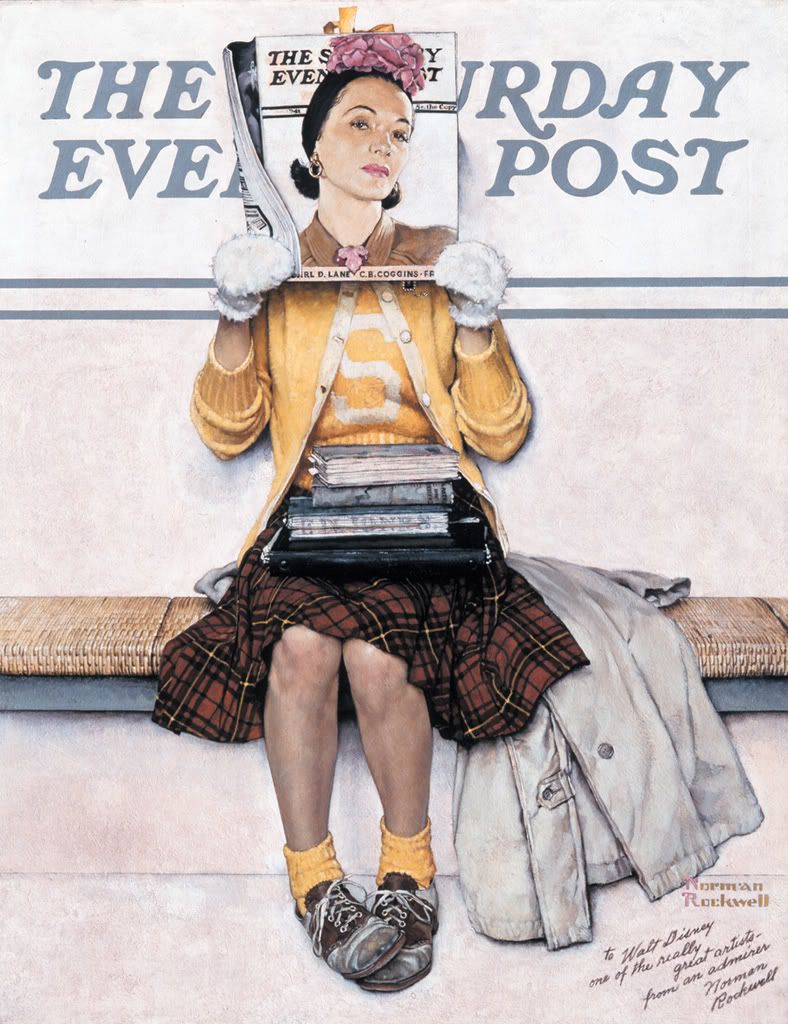
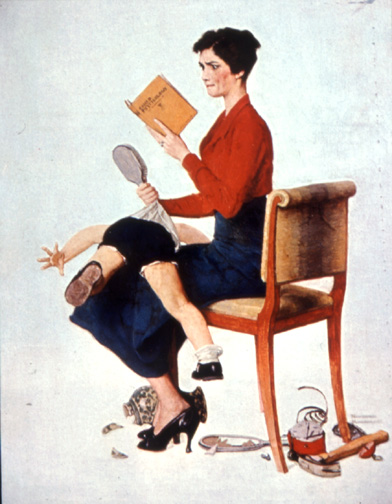
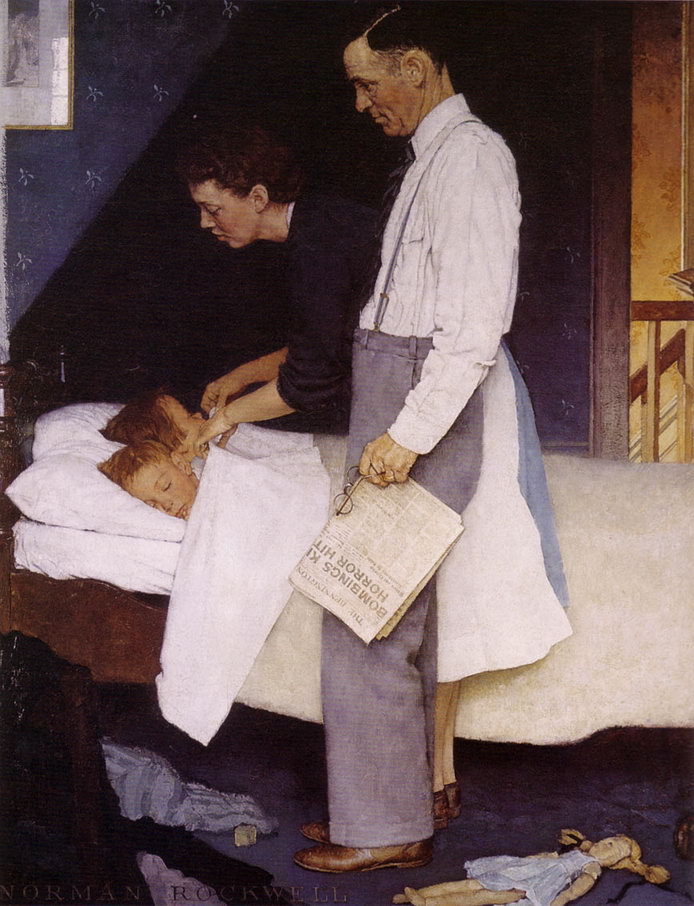
While in Vermont, one of our pursuits was the Normal Rockwell Museum. I grew up with these images in heavy wooden frames all around our house and was excited to take a closer look at some of his lesser-known paintings. I'd been to the museum a few years ago, but what interested me this time was Rockwell's portrayal of women. I was not disappointed.

What I found was a surprising openness to gender role transgression in Rockwell's children, well, specifically in regard to girls taking on traditionally male roles. In his illustrations, little girls are frequently shown as active participants in many games and sports. In some cases, they even seem to show up their male counterparts.


However, something changes at adolescence. The girls in his illustrations seem to receive a different message altogether. Note the progression here:


And while there are some surprising moments of seeming gender equality, what follows is a clear definition of separate spheres for men and women. Rockwell's adult subjects clearly do not have the freedom to transgress their gender roles as much as the children did.


Then again, Rockwell did somewhat redeem himself with Rosie the Riveter, modeled after a local telephone operator:


All in all, Rockwell offers a fascinating window into the construction and later transgression of gender roles in this country.

Talking feminism in Vermont

The coincidences with my best friend Sarah continue. No, not matching sweaters this time, but our Spring Break did happen to fall on the same week. This is a little odd, since my Spring Break never falls at the same time as anyone else's, but I'll chalk it up to divine feminist destiny.

I took a lovely train ride to Rutland, VT, where Sarah picked me up. We stayed at the Edgewater Resort for an amazingly low rate and watched people ice-fish on the lake outside our front window.

Here are a few of my favorite feminist highlights from the week:

1. The woman who owns Edgewater is at least 80 years old. She used a magnifying glass with a flashlight attachment to view our bill, and then when we asked if we could stay an extra night, she put the magnifying glass aside, looked up to the ceiling and said, "I like you girls." I liked her too, especially her sense of independence at 80. She ran an entire resort without a man in sight.

2. Where to begin with the conversations Sarah and I had? We talked about having male partners who encourage our independence, and how we'd go a little crazy if this weren't the case. We talked about the division of household labor and why it was such an issue for each of us. (In my case, my dad got home from work earlier than my mom but still contributed little to the housework.)

3. Sarah worked on a research paper regarding the social construction of motherhood and reminisced at the ways her own parents had encouraged her to participate in a variety of activities, regardless of her gender role. (Sarah was the only girl I knew in elementary school who could accurately shoot a bb gun, for instance.)

4. While I brought along a stack of my own books, I ended up curling up with one of Sarah's for most of our trip. It's called Alias Grace by Margaret Atwood and explores issues of class, gender, violence, and sex in nineteenth century Canada.

5. And then there was the wine we picked up for $3.99 a bottle, the locally produced maple syrup, and blocks of Vermont cheddar cheese. I'm not quite sure how these are exactly "feminist" in nature, but it just felt like they belonged on this list.

In short, it was a fabulous trip, and I recommend it for feminist friends everywhere.

P.S. All photos are courtesy of Sarah's "lens."

Wednesday, December 24, 2008

Ms. Claus

Tonight, many children will go to sleep with dreams of sugar plums dancing in their heads. They'll wake up tomorrow morning with one thought: Did Santa Claus come?

At my house, this meant kicking off the covers well before dawn to see if Santa had left our now-filled stockings at the foot of the bed. My parents had a rule: You didn't wake them up until dawn.

So, my brother sat crouched at the window, waiting for the first hints of Christmas morning light. Meanwhile, I'd inspect the house for evidence of Santa. The cookies were gone, with a note in shaky Santa handwriting, the presents were under the tree, and I could swear that I heard jingle bells on the roof late the night before.

Yet in all this magical mystery, I never once thought about what Mrs. Claus was doing on Christmas. We never left her cookies or sat on her lap, asking her for presents. (OK, my gender-inclusive mother did always make sure that a good majority of our presents were signed "From Mrs. Claus," but we still assumed that Santa was the one who actually brought them. In fact, we suspected that he signed her name sometimes just to make her feel better.)

I suppose I figured that Mrs. Claus just stayed home with the kids...er...elves on Christmas Eve like a good housewife. But now I feel bad for Mrs. Claus. I mean, for goodness sake, she doesn't even have a first name!

Instead, we know her only by her prefix, "Mrs.," which essentially defines her by her marriage to Santa. Mrs. Claus is the perfect example for why many women today choose the prefix "Ms." instead.

Popularized by Ms. Magazine in the seventies, this term does not reveal marital status. Many women (including me) find it important to be defined by more than whether or not they've been hitched. Men do it all the time. Can you tell if a "Mr." has been wed without looking at his ring finger? Nope. Then why should women be any different?

My younger cousins, Hannah and Chelsea, have a grade school teacher who goes by "Ms." On the first day of school, she explained to them that she uses "Ms." in order to be "mysterious." Hannah and Chelsea think this is hilarious, but intriguing. It's a great explanation, one that opened up discussion with them about women's prefixes. They were particularly fascinated when I told them that I, too, was a "mysterious Ms."

For far too long, women have been defined by their husbands, the way Mrs. Claus is only defined by being married to the jolly guy in the big red suit. Don't believe me? Do a quick search on Google Video for "Mrs. Claus," and you'll find videos that further epitomize the gendered stereotypes for a married woman.

She's either slut:

Or nag:

But this year, I have a new vision for Mrs. Claus. My Christmas wish is that she drop the "Mrs." prefix for the "mysterious Ms." Who knows what possibilities she'll find for herself? Maybe she'll realize that the red fuzzy outfit just isn't for her, and she'll swap it for a more sensible Anne Taylor pant suit. Maybe she'll take up snowboarding or ice-fishing. Maybe she'll revamp the workshop, using the skills she learned when earning her MBA ten years ago. Maybe she'll go back to school.

Embracing the term "Ms." does not mean turning one's back on one's spouse. I imagine Ms. Claus will still pack Santa a lunch for his long Christmas Eve journey (sans cookies, of course...those will be provided on the way). She'll wait for him eagerly on Christmas morning, maybe wearing some skimpy lingerie under her North Pole robe.

But he'll do the same for her -- make her dinner after her late night of classes, tidy up the workshop before she gets home from a long day of ice-fishing, and cuddle with her in front of the fire.

The term "Ms." offers them the opportunity to define their roles, instead of letting their roles be defined for them. So this Christmas, let's accept the opportunity to freely express ourselves in relationships, embracing the "Ms.-tery" of the season.

Sunday, October 26, 2008

Mamas, Llamas, and Votes


Today, our politically active church did not let us forget the fact that next week is election week. In fact, even the children's sermon was full of non-partisan political initiative.

Now, I'm used to children's sermons that consist of a brief object lesson involving a shoebox or a light bulb or a candy cane. In each case, all I knew as a kid was that the correct answer to any question was "Jesus."

But not so at my current church. Here, the children's sermon is usually one of the most moving portions of the service. These kids make you think. They make you reconsider the seeming simplicity of your faith.

So today, instead of the Ten Commandments or why we shouldn't tell a lie, the children's talk was about the complex history of women's suffrage.

There were several powerful moments in this short little conversation with the kids.

The first came when our pastor asked how many people in the congregation had a mother who was of voting age pre-1920 and consequently encountered a time in her life when she wasn't able to vote. Several hands shot up. Then, she asked how many people had a grandmother who was unable to vote. Nearly 3/4 of the hands went up.

It had never occurred to me how recent the suffrage movement really was until that moment. Suddenly, it became no longer some removed historical fact.

We're talking only a couple of generations ago. It's hard to imagine.

The second great moment of the children's sermon occurred when our pastor asked the kids why they thought women weren't allowed to vote back then. Our usually precocious kids didn't raise their hands. They had no guesses. They were stumped.

"Actually," Pastor Laurie said, "I'm glad you don't have an answer to that one. There were no good reasons that women weren't allowed to vote."

The congregation chuckled. We were proud of our kids. We realized that they've grown up in a world that has never told them that their gender is too uneducated, too weak, or too frivolous to vote.

I left church feeling even more driven to exercise my right to vote this election. And this led to an embarrassingly obsessive t-shirt buying frenzy. (Perhaps not the most politically-transformative way to get the word out, but nonetheless, it was fun.)

First, I got the following shirts for my mom and mother-in-law:


Then, I had to treat myself to the following:

The latter really has nothing to do with gender issues, but I've been trying to figure out how to incorporate llamas onto this blog for some time, and this is the best I can do. I mean, honestly, how could you refuse to vote for Obama when you've got this fuzzy, weird-looking creature egging you on?

Plus, who could resist the llama song?


In fact, with a few minor alterations, this could end up being our new National Anthem:


Regardless of whom you vote for, may we all remember that, unlike llamas, we as women do have the right to vote. And that's a relatively new and wonderful freedom.

Friday, October 10, 2008

Hallowing Gender

In case you haven't noticed the growing inclusion of giant spiders and ghastly orange pumpkins in the windows of nearly every commercial establishment in the U.S., let me be the first to remind you: 'Tis the season for Halloween.

For kids, this is a time of fun and innovation. For parents, it often means a lot of money and/or time spent on finding/making the perfect costume. (Mom -- think the Philly Phanatic costume you made for my brother out of green fuzzy fabric, cardboard, and an intricate welding of party-blowers...) For us childless twenty-somethings, Halloween means buying a whole bunch of our favorite candy and praying that very few kids knock on our door so we can EAT IT ourselves. :)

Halloween is an interesting time for gender observations because it's the holiday that is most conducive and, simultaneously, most restrictive for gender-bending. I remember, for instance, the majority of the guys in my eighth grade class coming to school dressed as women. For an example of the ridiculous costumes available for men, check out Amy's great blog that I've added to my blog roll. Eek.

But for many small children, Halloween is a time to strictly conform to gendered expectations. Go to any elementary school parade, and you'll most likely see girls dressed as princesses, and boys dressed as superheroes. The problem is that these roles enhance the dichotomy, which states that boys are supposed to be active and girls are supposed to be passive. This is evident in our most basic fairy tales -- the girl is the princess who needs rescuing, and the boy is the rescuer.

Books like the recent Christian bestseller Wild At Heart convince men to embrace these roles as the active, manly rescuer, the pursuant of adventure.

There's nothing wrong with the idea that men are active and risk-taking. The problem occurs when we as a culture assign the trait of adventure to men and men alone.

When we tell women that it is in their nature to be passive and nurturing, we often forget to encourage them to stand up for themselves, to take risks, to disagree when necessary, and to strive for their goals. When we tell men that it is in their nature to be active, we often forget to allow them the freedom to compromise, to display their authentic emotions, and to nurture their children.

It's fascinating to see the ways that these dichotomies play themselves out in Halloween costume selection. Take a look at just one website, specializing in Halloween costumes. They separate their costume selection into girls' costumes and boys' costumes. The girls' costumes consist almost exclusively of princess outfits, while the boys' are almost entirely superheroes. Note, too, how the girls are posed passively, as if modeling the costumes for someone else's gaze. The boys, however, are posed actively, as if they are ready to fight.

Dichotomies hurt both men and women.

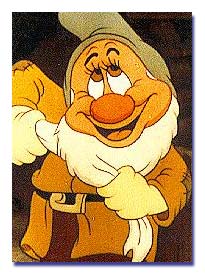
And yet it is clear that these dichotomies are taught not innate. For instance, my brother and I had a set of the seven dwarfs from Snow White. We'd play with them for hours on end. I was completely convinced that Bashful was a woman, despite the obvious evidence to the contrary. My parents actually had to clarify that ALL the dwarfs were male, despite Bashful's long eyelashes. Similarly, I was shocked when I discovered that Big Bird was a boy. I had so identified with his leadership and fun, that I just assumed that he was a girl like me.

When I think back to my own childhood, I remember the moments of strict gender conformity during Halloween -- I was Snow White one year, and my brother was Prince Charming. (OK, ignoring the odd incestuous implications of that one...let's move on...) My parents, however, were the dwarfs. Even now, this strikes me as so odd! A complete reversal of roles. My parents were obviously taller, yet they dressed as dwarfs. My mom was obviously female, but she donned a gray beard. So, maybe my brother and I were blessed because even in the midst of our moments of ultimate gender conformity, we were shown the freedom to be whatever we wanted to be.

Sunday, September 28, 2008

A shout out to my wonderfully unconventional youth group

Generally, when I hear the words "youth group," what comes to mind is lots of Kumbayaa-ing around a fire pit, a series of nonsensical group games involving whipped cream and paper bags, and a lesson that inevitably leads us all to repent of our weekly failings and draw closer to God.

So when my church asked Joe and I if we'd be youth group leaders, I had to seriously pause.

My parents were my youth group leaders when I was growing up, and they were always full of energy and earnest about their roles.

But in this era of postfeminist thinking, I had to re-evaluate what my approach youth group might look like. I decided that I'm anti-indoctrination, anti-God-as-father-but-not-as-mother, anti-religion-as-excuse-to-sit-back-and-wait-for-heaven, etc. You get the picture. So what's a feminist youth group leader to do?

Fortunately, I'd found this superbly crazy church family at Central Baptist Church, so I had nothing to worry about. (Don't let the Baptist fool you -- these guys and gals are into social justice, changing the world, serving the poor, welcoming the LGBT community, etc.)

At this weekend's annual youth retreat, we had the requisite group games and singing, but we also journaled, played with modeling clay, made up rhythmic chants as prayers, and painted.

My favorite activity this weekend came when one of the leaders asked the youth to create a craft project that reminded them of God. One kid drew an awesome picture of a muscular guy with tattoos. "I think God sits on a big couch up there with a high-def TV, making sure we're all doing alright," he said.

When someone asked him about God's tattoos, this kid said matter-of-factly, "Oh, isn't it obvious? God's been in the Navy."

I cracked up.

Then, another youth member said that God, to her, was a woman.

The kid sitting next to me read me his "Letter to God." It said:
God, please watch over us. You are a light saber. May the force be with you.
Another made a banner out of purple glitter that said "God is da bomb."

Unconventional? You bet. But what's wonderful about these youth is that they view God as this great creative being, as one who lives beyond rigid gender roles and can be man, woman, light saber and purple glitter all at the same time.

In short, I love each and every one of these youth for their quirky creativity. I love that they are all reflections of a God that I can believe in -- one who is full of love, joy, and endless, genderless possibilities.

Wednesday, June 25, 2008

Really, Alex.

He looks like a dufus in this picture, and tonight, he looked like a dufus on the show.

Just after anouncing that the Final Jeopardy category would be "The Heisman Trophy," host Alex Trebek quipped, "Uh oh. All the ladies just went ughhh."

Of course, the camera was focused on Alex and his amazing blue question board, so we couldn't see if the ladies did indeed slump towards the floor like sacks of potatoes in utter despair over a SPORTS category, of all things, or if they held their heads high.

What we did see was both "ladies" answering the question perfectly.

Really, Alex. Aren't we past this ignorance of women's interest in sports? Apparently not.

When I was twelve, my brother and I had the entire Philadelphia Phillies roster memorized. I played Little League with Mike Schmidt's number 20 proudly stamped on my back. We loved everything baseball.

Yet when my grandparents waited in line to get Mike Mussina's autograph (my dad had coached against his high school team), I ended up with his scrawled signature across the newspaper scrap that announced his visit, while my brother got a crisply signed new baseball, complete with one of those nifty plastic baseball holders.

Sibling rivalry, or gender disparity? This is why it's so complicated for women today. We sense that something is off, but we can't quite articulate it.

Consider this: from the moment we could walk, my brother and I were wielding plastic whiffle ball bats. My dad taught my brother to bat left-handed, even though he threw right-handed. It was an advantage against most pitchers. But I was just a girl. I was never taught to switch hit.

To be fair, my dad is quite the pro-feminist guy. I mean, how many other dads encouraged their pre-teen girls to play baseball with the boys?

Still, if we as a society can't get past these rigid gender roles, starting as early as childhood, we will continue to communicate, as Alex did tonight, that women are largely ignorant of sports. They're not cut out for it.

Well, Alex, Title IX was passed in 1972, and women are interested in sports: playing them, watching them, rooting for their teams.

I can't close this Jeopardy-related post without throwing up a cheer for Larissa Kelly, who became the third all-time money winner in non-tournament Jeopardy play this May. She's the highest female scorer in Jeopardy history. Great job, Larissa! Way to show Alex that women know about not only sports, but quite a bit of everything else as well!