Showing posts with label history. Show all posts

Monday, April 13, 2009

Sarah Gronert Update

It's been a few weeks since my last post. (Blame it on the end-of-the-semester blues and a stack of research papers to grade that reaches from floor to ceiling.) To make up for lost time and tide you over until my next post, I thought I'd give an update to one of my most popular previous posts.

I use Google Analytics to follow my blog's traffic, and never had I seen such a spike in interest than in regard to my post on Sarah Gronert, the transgendered tennis player. I was disturbed, not by the level of interest, but by some of they key words that folks used to try to find more information about Gronert. Key word searches such as "naked pictures of Sarah Gronert" and "what was sarah gronert's genitalia like" make me reiterate my claim that we need to stop broadcasting this woman's private life to the world and instead treat her like a human being.

The tennis world has done just that, and according to an article in the Telegraph, Gronert is allowed to play as a woman on the women's circuit. Of course, this didn't happen without a process of "gender verification," which involved a review of her "case."

I suppose this kind of invasive investigation is still relevant in a society where gender binaries are the norm, but it reeks of, say, the forced examination of prostitutes in the 19th century. The British Army, fearing "contamination" of venereal diseases, forced women to submit to invasive exams on a regular basis (even though the very same men were never examined), and if women were suspected of STD's, they were sequestered in a locked hospital until assumed "cured." According to the Victorian Web (a fantastic resource for everything Victorian, by the way), "These acts became a feminist cause because they permitted the police to detain and inspect any woman suspected of venereal infection, and, it was claimed, innocent women found themselves forced to undergo humiliating inspections."

As a result, a law that purported to protect women actually harmed them. I sense the same feeling of paradox in regard to Gronert's case. Certainly, she must feel vindicated by the WTA's ruling. I mean, it allows her to continue to compete in the sport she loves. At the same time, though, this victory did not come without a significant personal compromise. For heaven's sake, people are searching for pictures of her genitalia on the internet! Is this trade-off fair, or do our gender categories need amendment? I'd lean toward the latter.

Coincidentally this week, I was catching up on old This American Life episodes and found a wonderful little gesture toward a better understanding of transgendered people. For an insightful listen, check out the story "Tom Girls" from the February 13, 2009 program, "Somewhere Out There." You can listen to it online for free.

This story, and others like it, offers us corrective gender lenses-- a prescription that helps us see those that don't fall into prescribed gender binaries as real human beings.

Tuesday, March 24, 2009

Today's story in Women's Enews that every woman in this economy needs to read

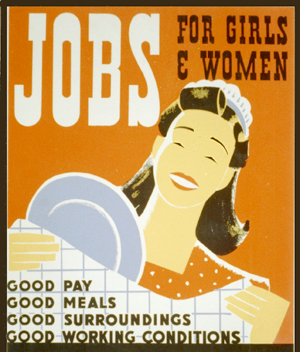
Obama's stimulus plan, while leaving out some key advances in women's health coverage, provides important employment benefits for women. Here are three of the key initiatives, as explained in today's Women's Enews:

---Benefits will now be provided to workers who must leave their jobs for compelling family reasons, such as caring for ill or disabled family members, relocating with a spouse whose job has moved to another area, or escaping domestic violence in which the abuser follows the woman to her workplace;

---The earning test now looks at the worker's most recent employment, instead of excluding the last three to six months, making it much easier for low-wage workers and new entrants to the work force (read: large numbers of women) to qualify for benefits.

---Benefits are now available to workers seeking part-time work which also includes many women.The author of the article,
Mimi Abramovitz, gives an astute account of previous governmental practices that have led to the gender wage gap and how these initiatives by Obama's administration will help to correct some of them.

Here's just one way that Abramovitz explains the gender gap:
Women lost out because these rules reflected and supported male work patterns that by definition penalized women. The hidden assumption--that low earnings and fewer hours of work reflected a weak commitment to work--disadvantaged women who receive less pay and work fewer hours because they still bear the brunt of family responsibilities.

i.e. if you were a woman who worked part-time so you could care for your children, the workforce labeled you as "lazy." In addition, Abramovitz points out that if a woman quit her job to move with her family to a new location (for her spouse's job), or if she moved to escape domestic violence, she was considered to have "voluntarily" quit. Now, the current administration is asking how "voluntary" such a move really is.

It's good progress, and while many women will still face incredibly difficult choices in this economy, I'm thankful that our goverment seems to be wearing a clear set of gender lenses.

Thursday, March 19, 2009

Happy birthday, Barbie.

Hard to believe, but she's 50 today. Thank God for botox...er...plastic, right?

So I could talk in this post about how harmful Barbie has been to women's body image for the last half century, but if you really think that nippleless size 38 boobs are a normal physicality to ascribe to, you've got problems...problems that this blog post isn't going to solve.

I could talk about how Mattel actually altered these unrealistic proportions in 1997 after so many complaints, but Bitch editor Lisa Jervis did it so much better in a Mother Jones' blog.

Instead, I offer two possibly fresh Barbie insights:

1. If you haven't already done so, buy the book Kinky by Denise Duhamel. It's still the funniest book of poetry I've ever read. Makes you see Barbie in a whole new light.

2. On another note, consider the ways that Barbie has instilled upon our culture the ideal of Caucasian beauty (yes, despite the later "ethnic" Barbies). What happens when we equate "beauty" with "whiteness?" The video below poses a very scary answer. Note, particularly, the study with the dolls...

Friday, March 13, 2009

Women writers

I just have to share this fabulous review by Katha Pollitt on Elaine Showalter's new book A Jury of Her Peers. It's more than a review of a really good book (that you should add to your Amazon wish list, as I just did). It's a commentary on the historical constraints on women writers and the way these constraints affect contemporary authors.

She asks these questions:
"More different than the books themselves is the gendered framing of how we read them. Nobody says Henry James is a less ambitious writer because he wrote The Portrait of a Lady and not The Portrait of a Sea Captain. If The Corrections had been written by Janet Franzen, would it have been seen not as a bid for the Great American Novel trophy, but as a very good domestic novel with some futuristic flourishes that didn't quite come off?"

It will make you think next time you browse the library shelves...

Saturday, March 7, 2009

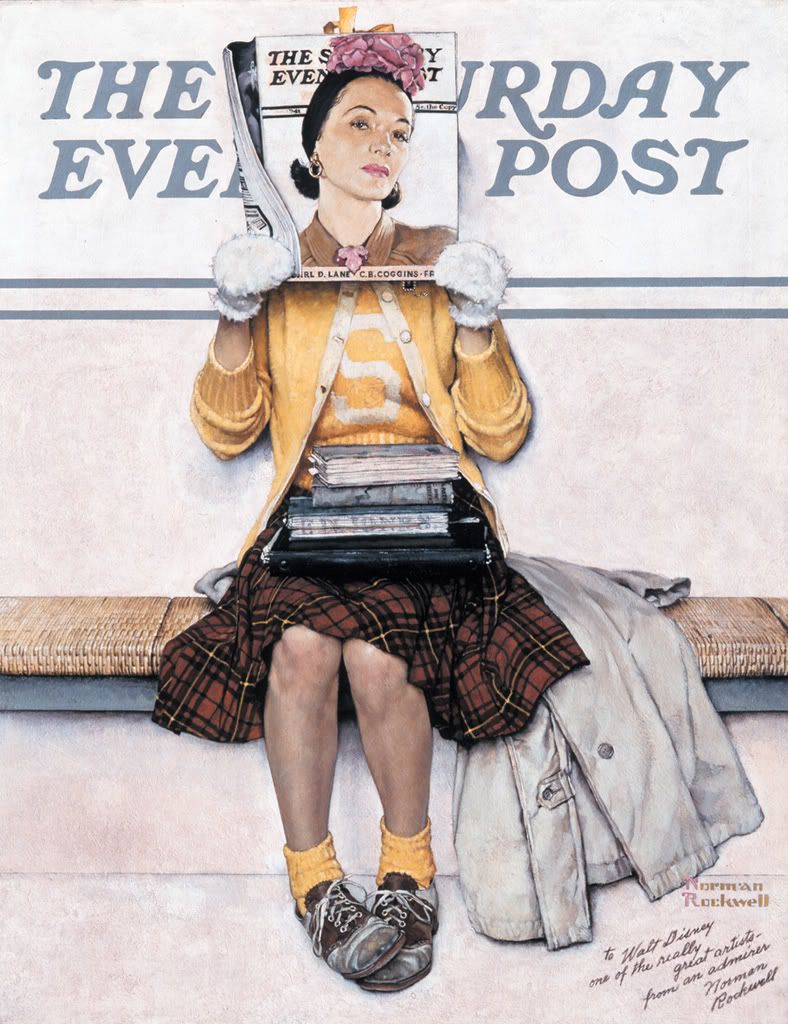
Gender as portrayed in Norman Rockwell's paintings

While in Vermont, one of our pursuits was the Normal Rockwell Museum. I grew up with these images in heavy wooden frames all around our house and was excited to take a closer look at some of his lesser-known paintings. I'd been to the museum a few years ago, but what interested me this time was Rockwell's portrayal of women. I was not disappointed.

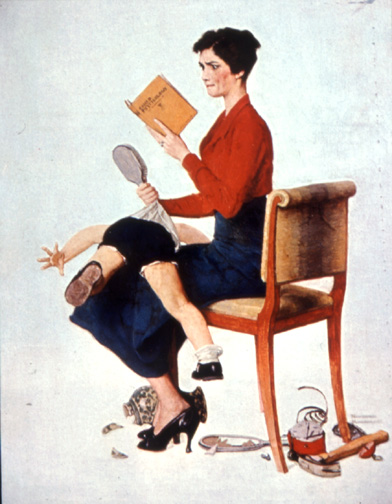
What I found was a surprising openness to gender role transgression in Rockwell's children, well, specifically in regard to girls taking on traditionally male roles. In his illustrations, little girls are frequently shown as active participants in many games and sports. In some cases, they even seem to show up their male counterparts.


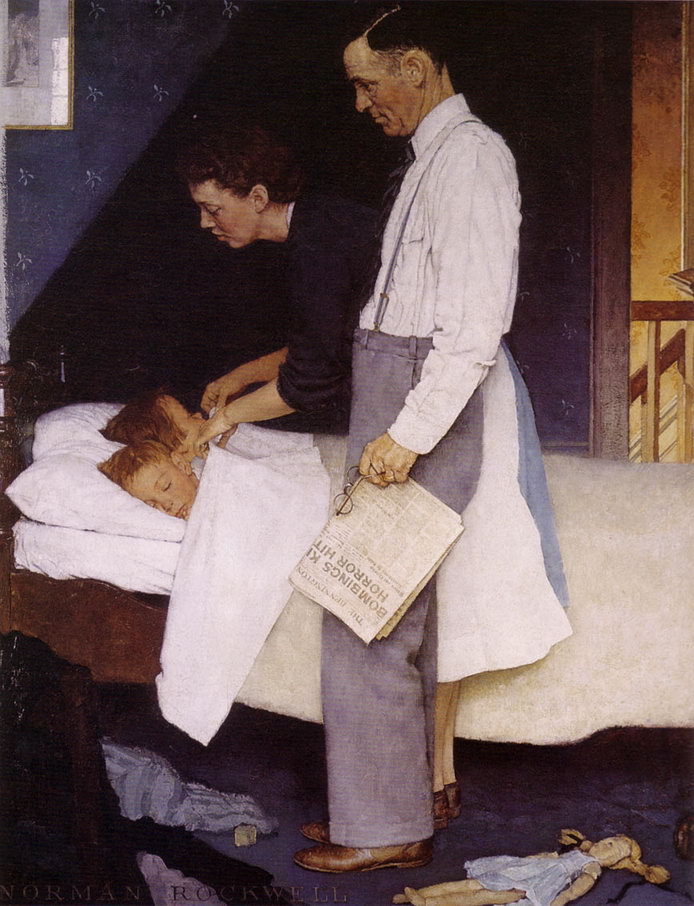
However, something changes at adolescence. The girls in his illustrations seem to receive a different message altogether. Note the progression here:


And while there are some surprising moments of seeming gender equality, what follows is a clear definition of separate spheres for men and women. Rockwell's adult subjects clearly do not have the freedom to transgress their gender roles as much as the children did.


Then again, Rockwell did somewhat redeem himself with Rosie the Riveter, modeled after a local telephone operator:


All in all, Rockwell offers a fascinating window into the construction and later transgression of gender roles in this country.

Sunday, February 22, 2009

A little "Changeling" needed for gender roles

Last night, my partner and I finally got a chance to watch The Changeling, directed by Clint Eastwood and starring Angelina Jolie. I'd been anticipating this movie since it's release months ago, and now that it's out on DVD, my expectations had grown to gargantuan proportions.

And I can't say I was disappointed. My partner, Joe, actually cried at this film, and anytime Joe cries at a movie, it gets two thumbs up from me. (My tear ducts are a bit less reliable, as anyone remotely familiar with my gene pool will tell you.)

The plot followed real events in 1928 when a boy, Walter Collins, was reported missing by his mother, Christine Collins. Five months later, the police presented Christine with a boy who claimed to be Walter, but was not in fact her son. Despite her protests to the contrary, the police refused to believe her stories and went as far as having her committed to a psychiatric ward against her will.

To me, the film's greatest triumph was it's ability to portray the cultural creation of hysteria in women. The word hysteria comes from the Greek hysterikos, which means "of the womb" or "suffering in the womb" (think of the English term, also derived from the Greek, "hysterectomy").

Hysteria became used as a catch-all diagnosis for "womanly diseases," especially those involving faintness, nervousness, sexual dissatisfaction or really any attempt by a woman to subvert the status quo. Particularly prevalent in the Victorian era, hysteria was frequently used as an excuse to institutionalize women who refused to ascribe to their place in society.

In laywoman's terms, it was what they labeled wild ass women in order to get them under control. And control is really what this movie is about. Almost all of those in power are men -- the police officers, the head doctor at the psych ward, and even the pastor who befriends Christine, yet controls her story for his own purposes.

Perhaps the only time in the movie when we find solace in female redemption from patriarchal control is in the psychiatric ward, when Christine meets another female patient, Carol Dexter, played by Amy Ryan (who plays Beadie in The Wire, one of my favorites). Carol explains to Christine that all her control has been taken away from her. If she asks to speak to the doctor in charge, she will be assumed to be unable to deal with authority. If she becomes silent, she is diagnosed as withdrawn. If she claims her innocence, she is seen as delusional. In short, she is trapped.

And while many women do not end up in a psychiatric ward, many certainly feel trapped by patriarchal forces, unable to find our voice or make ourselves be heard.

There are a lot of disturbing and haunting moments in this film, but what haunted me the most were the number of times that Christine, in all her unbearable grief and frustration, smiles -- actually smiles -- at the men in charge. It's as if she realizes that she's tried everything else, and nothing works. They won't listen to her directly, so she has to charm them instead. It's eerie.

So tonight, I'll be rooting for this film as I watch the Oscars. (See my next post for reasons why my cheering won't be quite as loud in other categories...)