Of course, advertisements on beauty are inescapable, and for the most part, I've grown rather numb to the inundating barrage of critiques on my appearance by the media.
But I've watched this Latisse commercial a few times now, and what disturbs me more than anything is that phrase, "for inadequate or not enough lashes." Here it is:
I want to know who determined that someone's eyelashes are "inadequate" or "not enough." What length or thickness qualifies as "adequate"? When is my facial hair "enough" but not excessive?
What further intrigues me about this commercial is that the product is FDA approved for the treatment of hypotrichosis. This is an actual medical term used to describe lack of hair growth.
I think there's a fine line between growing hair where there is none and using beauty products to create fuller lashes. The television commercial for Latisse seems incredibly misleading on this point. Is it a product to create lashes where none have grown, or is this a cosmetic product with similar effects to that of mascara? The ad is disturbingly unclear.
What is clear is that we, as a culture, are obsessed with proper hair growth. It has to grow in the right places at the right rate and with the right thickness. Any variation is aberrant. This is certainly an issue for both genders -- men struggle to conceal and reverse baldness, while women wax those unsightly hairs. Both genders shave.
I can't claim to be exempt from these practices myself. I care about how my hair (all of it) appears. I spend time every day making sure that my facial hair meets my culture's beauty standards.
But I worry when these beauty standards become defined as medical deficiencies that need to be "cured." The plastic surgery industry began this trend, asking women to fix everything from their noses to their lady parts. (Yes, I said "lady parts." Perhaps unbelievably, designer vaginas are the new trend.)
Products and practices like these continue to blur the line between aesthetic appearance and medical treatment. It's unsettling at best. At worst, it's dangerous, painful, and just another method for "fixing" women's inadequate bodies.
Time calls them "mancessories," or the fashion industry's latest attempt to suck men into its unattainable standards.
And when I say "suck," I mean it literally.
Yes, ladies, now as you stuff your cellulite into Spanx before sliding into that slinky cocktail dress, your male counterpart can do the same. (Well, maybe sans dress. Maybe.)
Apparently, along with murses (purses for men) and mandals (sandals for men), a company called Equmen is producing Spanx-like undergarments that enhance the six-pack abs look and (and this is perhaps my favorite part of the Time article) "keep their precision parts cooler."
Contrary to popular belief, subjecting men to the same kinds of ridiculous fashion scrutiny as women is not the equality that most feminists are seeking.
However, sometimes watching the fashion world require these standards for men brings to light how ridiculous they were in the first place when applied to women. I mean, since when did our culture become obsessed with tightly sucking our bodies into one "ideal" form? It's like the return of the Victorian corset, and it actually makes me long for the oversized t-shirts of the '80's. Seriously.
The dilemma presented by the fashion industry's simultaneous obsession with thinness and "natural beauty" is perhaps best epitomized in that great scene from Bridget Jones's Diary, when Bridget has to decide between the Spanx-like, form-sucking underwear that come up to the top of her stomach (and are thus unattractive to a lover, should the evening progress to that point) and the Victoria's Secret thong-like number (that should encourage said lover in his pursuit once he's begun, but may not create the attraction necessary to initiate the undressing in the first place).
Now, I can't help but wonder if men will face the same dilemma. Will a man ask himself if a fake six pack and an enhanced sense of "precision parts" is worth the price tag and the possible subsequent humility when his partner discovers that his looks are not "natural"? With the prevalence of plastic surgery, this doesn't seem too far off the mark.
If you've seen this video posted on everyone's Facebook page, tweeted about on Twitter, and watched thousands of times on Youtube but just assumed it was another American Idolesque fad, you couldn't be more wrong.
I've now viewed it four times, and each time, I burst into tears. I thought it was just me, but then I showed my rather stoic partner, Joe, and he, too, burst into tears. In fact, he promptly watched it through a second time and then pulled out our Les Mis soundtrack and declared that Susan Boyle's version was better.
So what is it that gets us about this woman? I mean, the whole world seems incredibly moved and affected by Boyle's performance.
While Simon Cowell and the other judges touched on it a bit, I think they need the aid of a gender lens to truly understand what all the hype is about. It's not just that Boyle appeared frumpy, nervous, and goofy before pulling off a sincerely moving performance; it's that she defies our expectations of an acceptable female singer. Namely, she's shown that good looks are not a requisite for the presence of a good voice.
I would venture to say that most of the audience -- me included -- assumed that an older gray-haired woman with bushy eyebrows, dressed in a faded housedress, could not have a decent voice. I don't think we hold men to nearly the same standards. (Consider, for instance, gray-haired Taylor Hicks or overweight Ruben Studdard, both American Idol winners.)
In fact, we frequently offer disdain to female performers who do not match our society's stereotypes in terms of female beauty and body image. Think of Queen Latifah, once celebrated for her curvaceous vivaciousness, now spokeswoman for Jenny Craig. Marie Osmond is spokeswoman for Nutrisystem, and Wynonna Judd is the celebrity representative for Alli, a weight-loss drug. Over and over again, the message seems to be that female performers are not acceptable if they are not skinny, wrinkle free, and flawless.
Susan Boyle defies that image, and she does so with a lovable quirkiness and confidence. And now that record companies are knocking at her door, my only prayer is that she does not give in to the pressure to conform. I want her to grace her first album cover, wrinkles and all, with her gray hair wisping in every direction and her housedress clinging to her sides. I want this woman to continue to show us that look aren't everything and that regardless of what society tells us, we can dream any dream we darn well please.
Hard to believe, but she's 50 today. Thank God for botox...er...plastic, right?
So I could talk in this post about how harmful Barbie has been to women's body image for the last half century, but if you really think that nippleless size 38 boobs are a normal physicality to ascribe to, you've got problems...problems that this blog post isn't going to solve.
I could talk about how Mattel actually altered these unrealistic proportions in 1997 after so many complaints, but Bitch editor Lisa Jervis did it so much better in a Mother Jones' blog. Instead, I offer two possibly fresh Barbie insights:
1. If you haven't already done so, buy the book Kinkyby Denise Duhamel. It's still the funniest book of poetry I've ever read. Makes you see Barbie in a whole new light.
2. On another note, consider the ways that Barbie has instilled upon our culture the ideal of Caucasian beauty (yes, despite the later "ethnic" Barbies). What happens when we equate "beauty" with "whiteness?" The video below poses a very scary answer. Note, particularly, the study with the dolls...
A fascinating debate has ensued over tennis pro Sarah Gronert, who was born with both male and female genitalia. The question is whether or not she should be allowed on the female competition circuit.
Three years ago, amid intense scrutiny and harassment from friends and the media, Gronert underwent surgery to remove the male genitalia. The whole ordeal almost made her quit tennis altogether.
I don't blame her. Can you imagine having your genitalia discussed and criticized all over the news?
This is one of those moments when the debate itself is not good enough. Instead, we need to remember that we're dealing with a human being here.
My mom works in the medical profession, and I remember the first time she encountered a transgendered patient. She called me just about every day, telling me that the young person was very ill (with an illness unrelated to sexual reassignment surgery), and how much compassion my mom felt for her. My mom said to me, "I don't know if I should call the patient 'him' or 'her.'" We talked about what was acceptable (in this case, the gender one has chosen in surgery) and how it's completely appropriate to ask the patient's preference. But more importantly, I told my mom that the best thing she could do was to care for this individual and offer compassion.
My mom comes from a relatively conservative church background, and in our small town, transgendered folks are not generally visible to the public eye. I was a little concerned that my mom would act awkwardly, but on the fourth day that the person was in the hospital, Mom called and said, "I realized today that it doesn't even matter what gender she is. She's just a human being who is in need of care."
The issue of transgender individuals is a complex one because it defies our society's definition of gender binaries. We like to cling to our "firm" ideas of male and female, despite evidence to the contrary.
The APA defines transgender as the following: Transgender is an umbrella term used to describe people whose gender identity (sense of themselves as male or female) or gender expression differs from that usually associated with their birth sex. Many transgender people live part-time or full-time as members of the other gender. Broadly speaking, anyone whose identity, appearance, or behavior falls outside of conventional gender norms can be described as transgender. However, not everyone whose appearance or behavior is gender-atypical will identify as a transgender person.
Here's an excerpt from an eye-opening article from the Advocate that describes how high the transgender population really is:
Next time you find yourself in a crowd of 5,000 people, consider this: In the crowd there will be on average one person living with muscular dystrophy. There will also be on average two people who have already undergone male-to-female sex-reassignment surgery. And there may as many as 75 in that crowd who fall under the transgender umbrella. Are you surprised?
And while novels like Jeffrey Eugenides' Middlesexare bringing this issue to light, there is still much ignorance surrounding the topic.
I wish our society would stop attacking Sarah Gronert, the individual, and instead allow this situation to cultivate dialogue on our binaries of gender in the first place. In many ways, we've stopped volleying the issue of gender identity in thoughtful ways. Instead, we've served up a verdict on Sarah Gronert that is anything but love-love.
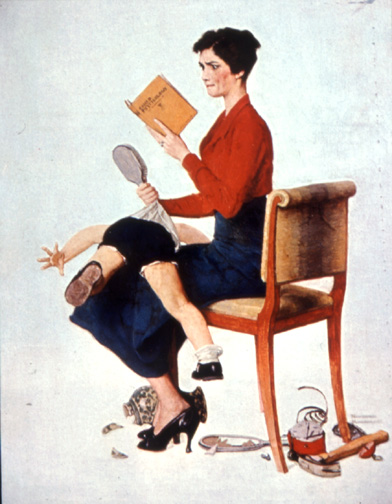
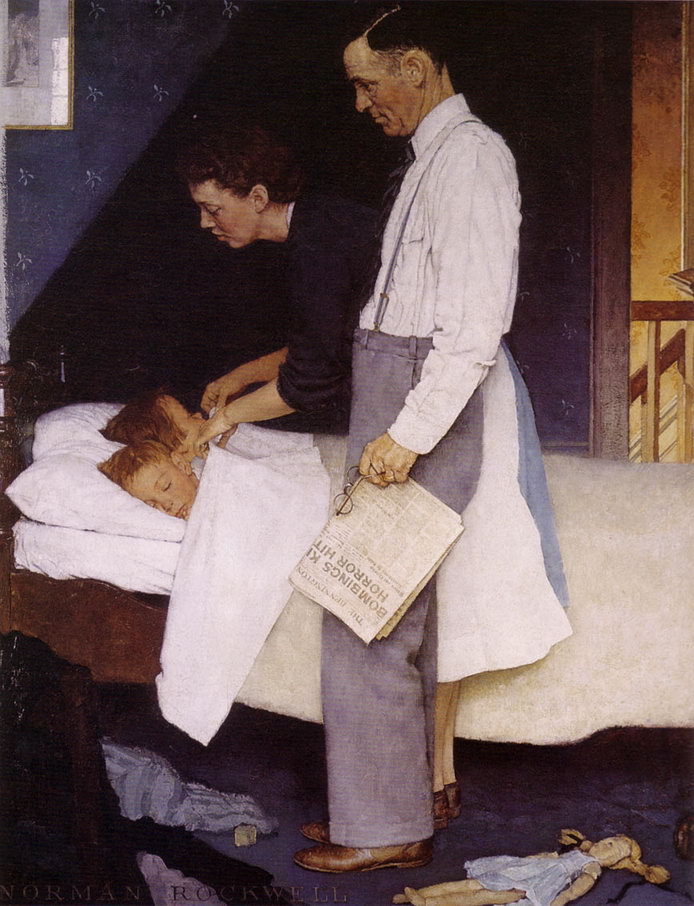
While in Vermont, one of our pursuits was the Normal Rockwell Museum. I grew up with these images in heavy wooden frames all around our house and was excited to take a closer look at some of his lesser-known paintings. I'd been to the museum a few years ago, but what interested me this time was Rockwell's portrayal of women. I was not disappointed.
What I found was a surprising openness to gender role transgression in Rockwell's children, well, specifically in regard to girls taking on traditionally male roles. In his illustrations, little girls are frequently shown as active participants in many games and sports. In some cases, they even seem to show up their male counterparts.
However, something changes at adolescence. The girls in his illustrations seem to receive a different message altogether. Note the progression here:
And while there are some surprising moments of seeming gender equality, what follows is a clear definition of separate spheres for men and women. Rockwell's adult subjects clearly do not have the freedom to transgress their gender roles as much as the children did.
Then again, Rockwell did somewhat redeem himself with Rosie the Riveter, modeled after a local telephone operator:
All in all, Rockwell offers a fascinating window into the construction and later transgression of gender roles in this country.
Perhaps you've heard of the new term "sexpresso," the melding of Hooter's-style waitresses with a Starbucks-type barista. There's Cowgirl's Espresso, whose theme is "Giddy Up;" Java Girls, featuring "sexy barista models;" and The Sweet Spot Cafe, where you can get "a delicious drink with a wink and a smile."
But now, the coffee industry has thrown bikinis aside in favor of topless coffee. In Vassalboro, Maine, the Grand View Topless Coffee Shop is open for business.
Interestingly, the company is reported to have received 150 applicants for the 10 positions available. This begs the question: Is this kind of employment degrading or empowering to women, particularly in this economy?
According to the local newspaper's report, here are what the topless waitresses themselves are saying:
Asked whether the shop is degrading to women, [Susie] Wiley said, "No, I love it. I find it very empowering, not degrading."
"It's just a body part," [waitress Kris Kelley] said. "There are more serious issues to worry about in this country than something like this."
Of course, many female residents of the town have a different opinion entirely. Still, one has to wonder, if these women are in control of the ways they choose to reveal their bodies, are they being objectified? If they find this to be a choice for economic survival, is it still a choice? Feel free to log your opinions in the comments section.
I do have to say that while the sexpresso shops mentioned above are mostly run by women, the Grand View Topless Coffee Shop is run by a man...a man who lives in the motel attached to the shop.
I think this is sort of creepy.
And the owner's comment in the local newspaper story?
We want to keep the girls respectable, not trashy...The biggest thing is keeping people happy.
Hmm...one has to wonder who he's keeping happy: the waitresses or the clients.
According to a recent poll, while women are more likely to make a New Year's resolution (74% of women vs. 58% of men), they are less likely to keep it (14% of women vs. 22% of men).
Does this mean we women lack tenacity? That we're unable to set goals and stick to them? That we have some kind of mental impairment when it comes to making our dreams a reality?
Perhaps. But it's more likely that most of us aren't making resolutions that have anything to do with our dreams and goals. All around the world, the resolution that repeatedly reaches the top of the list is weight loss. Some are even adding plastic surgery to the mix. And even in this struggling economy, gyms are still doing all right. According to the International Health, Racquet & Sportclub Association, "January is a huge month for health clubs, with about a million people joining nationwide -- 50% more than during any other month of the year."
Certainly, there's nothing wrong with wanting to be healthy, but for many women, this kind of resolution impedes a more meaningful commitment to self-advancement. We are constantly reminded that the goals for the upcoming year must place our looks first, the rest of our lives second.
And while most diets, particularly those approved by your physician (that was a shout out to my mom), can be helpful in achieving a healthy weight, there are some diets out there that are just plain harmful to women.
MOST OUTRAGEOUS CLAIM: Kevin Trudeau infomercials. This past August Trudeau was fined over $5 million and banned from infomercials for three years. In “willful efforts” to deceive, Trudeau told listeners they could easily follow the diet protocol at home, even though his book calls for human growth hormone injections and colonics that must be done by a licensed practitioner.
WORST GIMMICK: Skineez jeans($139). A new item in the fight against cellulite, Skineez jeans are impregnated with a so-called “medication” of retinol and chitosan, a shellfish product once claimed to cut fat absorption in the stomach (see 1999 Slim Chance Awards). Friction between the jeans and skin supposedly triggers release of the substance, which goes to work on fat when absorbed through the skin. Reportedly a big hit in Europe, the “smart fabric” is also used in lingerie. The FTC, however, is clear about such gimmicks, emphasizing that products worn or rubbed on the skin do not cause weight loss or fat loss.
WORST CLAIM: AbGONE. Claims are that AbGONE increases “fat metabolism” and calorie burn, promotes appetite suppression and inhibits future abdominal fat deposits. These are drug claims that, if true, would alter the body’s regulation, but unlike drugs, the pills are sold as food supplements not requiring FDA approval. The bold ads feature the obligatory before and after shots of models, cut-away sketches of the abdomen with and without belly fat, and a white-coated researcher with chart purportedly confirming success of 5 times reduction in fat mass, 4 times lower BMI, 4 times greater weight loss than placebo. No added diet and exercise needed – well, except, you may want to heed the fine print disclaimer at the bottom that reminds us “diet and exercise are essential.”
WORST PRODUCT: Kimkins diet. It must have seemed an easy way to get rich quick. Founder Heidi “Kimmer” Diaz set up a website and charged members a fee to access the Kimkins diet, boasting they could lose up to 5 percent of their body weight in 10 days. “Better than gastric bypass,” there was “no faster diet,” and in fact she herself had lost 198 lbs. in 11 months. Stunning “after” photos were displayed. In June 2007 Women's World ran it as a cover story, and that month alone PayPal records show the Kimkins site took in over $1.2 million. Then users began complaining of chest pains, hair loss, heart palpitations, irritability and menstrual irregularities. This was not surprising since Kimkins is essentially a starvation diet, down to 500 calories per day and deficient in many nutrients (appallingly, laxatives are advised to replace the missing fiber). In a lawsuit, 11 former members are uncovering a vast record of Diez’s alleged fraud. They found that the stunning “after” photos, including one of Kimmer herself, had been lifted from a Russian mail order bride site. According to a deposition reported by Los Angeles TV station KTLA, Diaz admitted using fake pictures, fake stories and fake IDs, and a judge has allowed the litigants to freeze some of her assets.
So what's a New Year's woman to do? Stay tuned, as tomorrow I'll be posting some innovative alternatives to the typical resolution.
I'm a writer and a photographer.
It's all really the same process: 1. Decide what you want to see through the lens or on the page.
2. Let light in.
3. Process.






 Posts
Posts


