Well, I'm back from the west coast with many blogs a bubbling in my mind. I could write about Michael Jackson or Farrah Fawcett, or the drama of John and Kate Plus 8. I could share with you insights from my students at the Oregon Extension Women's Studies May Term. And I may do all of that in the coming weeks.
But for now, I'd like to get a little closer to home. Well, actually, as close as you can get.
The news is that yesterday my partner and I closed on our first home. This means that in the 8 years that we've known each other, we will be living in the same semi-permanent residence for the first time. (Well, actually, last April was when we started living together long-term, but we were still renting, and for us, this was like the 15th place we've rented since college.)
We are totally psyched. However, with every big decision in life, the Nosy Onlookers must ask their prying questions. For years, it was "When are you getting married?" Then it was, "When are you and Joe going to live in the same state?" Now, the question we get at just about every wedding we attend is, "When are you having children?"
I have several qualms with this question, but my main qualm is that the question (and the others before it) is based on the assumption that we've already decided to have kids. The matter is simply "when."
For us, this is not the case. We are still wrestling with the decision of whether to have children at all. And the problem with the question is that it assumes an agreed upon normalcy for married folks. It's "normal" to have children, just like it was supposed to be "normal" that we live together after we get married. (When we didn't live together consistently, because of jobs and grad school, the Nosy Onlookers had a canary.)
In the Second Wave of feminism, women tried to redefine "normal." They said that it wasn't necessarily "normal" for a woman to stay home and raise her children. Maybe there was another option available. Now, contemporary feminists are asking similar questions. What if it's OK to remain single? To adopt? To decide not to have children? To have a same-sex life partner?
So, for now, my partner and I will ignore the gossipers and do our own thing, which is really what we've been doing all along.
And in the meantime, here's a video of our first day moving into the new house, when our dog jumped over a brick wall to a fifteen foot drop below. He was thankfully unscathed by the whole ordeal, but perhaps this is just another sign that we're not quite ready for the responsibility of children!
The leap (although because I'm looking at the view, Gus is just a blur)...
He really was completely OK. Thank God! :)
Friday, June 26, 2009
Buying a house does not necessarily lead to children
Posted by
Rebecca Lauren
at
10:27 AM
3
comments
Thursday, March 12, 2009
The Disney fairy tale wedding fantasy continues
First, a disclaimer: I am really a huge Disney fan. I grew up with all the classics, visited the theme park (even as an adult), and I still have my old Winnie the Pooh stuffed animal who is at least 2 decades old.
And while I'm thankful to Disney for teaching me that even roly poly bears like Pooh deserve to be loved for their fluff and stuff, and that, in the end, good usually triumphs over evil, I'm pretty mad at Disney for messing up my perceptions of love.
It took me a long time to recognize that despite my tomboy nature and my sense of independence, I too had fallen victim to the fantasy of the Disney fairy tale princess mentality. For most of my teenage and college years, I assumed that marriage would make me happy. I wore dresses to proms, dreamed of big diamond engagement rings, and planned out the perfect wedding in my mind.
And get this: I actually owned a wedding journal when I was all of 17 years old. You may be wondering, what in the hundred acre woods is a wedding journal? Well, I'll tell you. It's a place where you write down all of your wedding plans, like the following (which were actually part of said journal):
-Buy a dress with lots of tulle (which now makes me say "GOOD GOD, WHAT WAS I THINKING?")
-Give my husband the letter I wrote to him when I was 17. (I had written this letter to my future husband, whomever that might be. It was the cool thing to do as a Christian girl who wasn't allowed to have premarital sex. You were supposed to channel that energy to the imaginary man with whom you'd one day have sex and envision all the things that he would be. I've since wished that I could find this elusive letter to see all the ways that Joe DOESN'T meet my 17-year-old requirements... which is, of course, a very, very good thing.)
-Release butterflies at the end of the ceremony. (Little did I realize that to do this, the butterflies have to be shipped overnight, and some inevitably die in transit. Then, every guest gets a little box to open at the big "release" moment. After learning all of this, I had nightmares about my flower girl excitedly opening her box to a dead butterfly and spending the entire reception in tears.)
So the problem with all of these obsessive wedding-planning practices is that they perpetuate the Disney fairy tale myth, namely that marriage makes all stories end happily ever after. As most committed, monogamous couples know, the moment you pledge to stay together "as long as you both shall live" is the moment when things actually begin to get hard...really hard. And ten years later? Things get harder.
In short, Disney LIED!
Yet many heterosexual women rush into marriage, buoyed by the hope of eternal bliss that Disney so carefully portrays in Cinderella, Snow White, and Sleeping Beauty (the triad of princess classics). In addition, many women choose to stay in relationships that have long gone sour (or worse, that have turned abusive) because they cling to the idea that their marriage should be happy and their princess lifestyle should last and last.
So should it surprise us that beginning in 2007, Disney unveiled its line of princess-inspired wedding gowns? Here's what they have to say about every girl's socially constructed "dream":
The Gown, The Slipper, The Kiss and The Prince. Under it all, every girl believes in the dream. So here is our tribute to fairy tale wishes and finding true love.
Guess it's time to get out those wedding journals, ladies. (Just try to avoid the dead butterflies, if you can.)
Tuesday, March 10, 2009
The most important day of your life
...is, according to a new book, your wedding day. Ah yes, it's not the the day you earned your degree, that vacation in Italy you'd dreamed of taking your whole life, or the birth of your favorite niece. It's the day in which many women still vow to obey their husbands.
I won't even begin to rant about how heterosexist this whole thing is, or how it relies upon the idea of biologically-inherited gender roles. Why can't a person of faith give us all a book about how to be better partners? In general? Regardless of gender or sexuality?
Sigh...
I will rant (albeit briefly) about how ridiculous it is that apparently a male author knows best about what you need to know about becoming a "godly wife."
It's ridiculous.
(That's my rant.)
But fear not! There's also an edition custom made for the new groom! Because, according to the product description on amazon.com "As the soon-to-be spiritual leader of a new family it's important that a man of faith establishes a firm foundation on which his family will be built."
...because apparently women can't be expected to be spiritual leaders.But hey, at least it's fashionable: "The elegant black tuxedo stripe LeatherSoft binding makes this Bible the perfect gift for any groom who wants a firm footing as he journeys down the path to marriage!"
I guess that's the secret of marriage I've been missing all these years. If only I had a Bible for brides, I'd really know how to make my husband happy.
And my happiness? Not a problem. At least I'd get the chance to experience the most important day of my life. Who cares about what comes next? All I need is one day of bliss. The rest is downhill from here anyway, right?
Posted by
Rebecca Lauren
at
3:37 PM
0
comments
Labels: literature, marriage, religion
Saturday, March 7, 2009
Talking feminism in Vermont
The coincidences with my best friend Sarah continue. No, not matching sweaters this time, but our Spring Break did happen to fall on the same week. This is a little odd, since my Spring Break never falls at the same time as anyone else's, but I'll chalk it up to divine feminist destiny.
I took a lovely train ride to Rutland, VT, where Sarah picked me up. We stayed at the Edgewater Resort for an amazingly low rate and watched people ice-fish on the lake outside our front window.
Here are a few of my favorite feminist highlights from the week:
1. The woman who owns Edgewater is at least 80 years old. She used a magnifying glass with a flashlight attachment to view our bill, and then when we asked if we could stay an extra night, she put the magnifying glass aside, looked up to the ceiling and said, "I like you girls." I liked her too, especially her sense of independence at 80. She ran an entire resort without a man in sight.
2. Where to begin with the conversations Sarah and I had? We talked about having male partners who encourage our independence, and how we'd go a little crazy if this weren't the case. We talked about the division of household labor and why it was such an issue for each of us. (In my case, my dad got home from work earlier than my mom but still contributed little to the housework.)
3. Sarah worked on a research paper regarding the social construction of motherhood and reminisced at the ways her own parents had encouraged her to participate in a variety of activities, regardless of her gender role. (Sarah was the only girl I knew in elementary school who could accurately shoot a bb gun, for instance.)
4. While I brought along a stack of my own books, I ended up curling up with one of Sarah's for most of our trip. It's called Alias Grace by Margaret Atwood and explores issues of class, gender, violence, and sex in nineteenth century Canada.
5. And then there was the wine we picked up for $3.99 a bottle, the locally produced maple syrup, and blocks of Vermont cheddar cheese. I'm not quite sure how these are exactly "feminist" in nature, but it just felt like they belonged on this list.
In short, it was a fabulous trip, and I recommend it for feminist friends everywhere.
P.S. All photos are courtesy of Sarah's "lens."
Posted by
Rebecca Lauren
at
12:22 PM
0
comments
Labels: childhood, friendship, literature, marriage, parenting
Friday, February 6, 2009
International Gender Lens: QUEBEC
For many of the last few posts, I've focused on gender issues in the United States, particularly in regard to politics. Now, however, I'd like to introduce a new feature of this blog: the International Gender Lens.
Every few months, I'll be interviewing folks who live in other parts of the world, asking them what their noticing about gender constraints in their neck of the woods. My hope is that this will help us as feminists see things a bit more globally, allowing us to widen our sense of "women's issues" to include more than just an American agenda.
Granted, I haven't traveled very far for this first entry. I mean, for goodness' sake, we share a border with Canada already. However, Quebec is a place with a unique identity, one that doesn't always conform to those of its geographic neighbors.
Enter my best friend since first grade, Sarah. After college, Sarah moved north to Quebec City and has lived their ever since. She's married to a Quebecois and teaches English as a second language. She's also studying literature.
First, a little explanation of this picture. After a 12 hour train ride to visit Sar, I looked across the station in Montreal to discover...well...my twin. As you can see, Sarah and I are wearing pretty much the exact same pink and brown striped sweater. This is a pretty good example of how in sync we are, even from many miles away.
Not to stretch this metaphor too far, but this is the kind of thing I'm hoping for in the International Gender Lens: the experience of traveling all over the world only to find that women have more in common with one another than we might think. While recognizing our different struggles, we can find allies in each other. This is my hope.
RL: What's one negative gender issue that you notice in Quebec that you didn't notice in the U.S.?
SM: In Quebec, where I now live after growing up in central Pennsylvania, women must keep their maiden name at marriage. This is great…a tenet of the feminist credo. The problem is that women married in Quebec cannot choose to take their husband’s last name if they desire to do so. Even more creative solutions to the “last name dilemma,” such as a combination of the husband’s and wife’s last name are not permitted. So can this political stance be considered feministic or simply restrictive?
Freedom of choice is one of the core values of our post-modern society. So Quebec’s supposedly-feminist stance forcing women to keep their maiden names is in fact as limiting as laws obliging women to take their husbands’ names. Some women, even self-identified feminists, would choose to take their husbands’ names. One reason is so that their families can be identified as a unit, each member having the same last name.
Since married couples cannot share the same last name, this law complicates choosing last names for children. If given a name combining the last names of both parents, the children now have different last names than both their parents. It becomes even more complicated when children with hyphenated last names marry other children with hyphenated names. What names do they choose for their children? Will their children have four last names? Most likely not; so a choice will have to be made. In most cases in Quebec, couples in this predicament choose the last names of their fathers, which is just as patriarchal as the traditional system.
This “last name debate” reminds me of Ammu’s dilemma in Arundhati Roy’s The God of Small Things. Although her twins were seven years old, she still had not given them a last name:
"For the time being they had no surname because Ammu was considering reverting to her maiden name, though she said that choosing between her husband's name and her father's name didn't give a woman much of a choice."
I want women (and men) to choose the last name that they deem the best solution for them. It bothers me that my government dictates to women that the only way to be feminist is by keeping their fathers’ names.RL: What's one positive development in regard to women that you appreciate about Quebec?
SM: Quebec has actively promoted a gender-equal society. One way that the Quebec government has done this is by instating a public daycare system that only costs the users seven dollars a day. This means that many mothers can work without exhausting most of their income on child care. The program’s raison-d’être is, “to help parents balance their work and family responsibilities."
Another of Quebec’s policies, its Quebec Parental Insurance plan, inaugurated in 2006, has led to greater gender equality in the workplace. One year “maternity” leave now includes fathers, so men no longer have an advantage when applying for a job since the employer recognizes that a man may choose to take parental leave. Employers that had been weary of hiring women because she may take a year’s maternity leave cannot justify such a decision any longer.
Couples have taken advantage of this program. In Canada about 90% of mothers took leave from their jobs. In Quebec, 80% of men choose to take parental leave. (2006 figures).
One reason that so many Quebecers have used the program is that the policy is very flexible. The parents can choose to split or even share the year. The government provides seventy-five percent of the salary and employers are required to retain the same position for when the worker returns to work. The government pays up to 75% of the salary the person is missing during the leave.
3. Can you share a moment this very week where you personally encountered a gender issue?
Well, I've spent most of this week studying, so I guess I'd say that when I think of education, I'm grateful that I live today and not even 100 years ago. Also, I know that even if I do have kids, I can continue my education as a mom. I don't know if it's the same in the States, but moms can get the same grants and loans going part-time to college as those without kids get as full-time students.
Posted by
Rebecca Lauren
at
9:31 AM
1 comments
Labels: international gender lens, marriage, parenting, politics, traditions
Wednesday, December 24, 2008
Ms. Claus
Tonight, many children will go to sleep with dreams of sugar plums dancing in their heads. They'll wake up tomorrow morning with one thought: Did Santa Claus come?
At my house, this meant kicking off the covers well before dawn to see if Santa had left our now-filled stockings at the foot of the bed. My parents had a rule: You didn't wake them up until dawn.
So, my brother sat crouched at the window, waiting for the first hints of Christmas morning light. Meanwhile, I'd inspect the house for evidence of Santa. The cookies were gone, with a note in shaky Santa handwriting, the presents were under the tree, and I could swear that I heard jingle bells on the roof late the night before.
Yet in all this magical mystery, I never once thought about what Mrs. Claus was doing on Christmas. We never left her cookies or sat on her lap, asking her for presents. (OK, my gender-inclusive mother did always make sure that a good majority of our presents were signed "From Mrs. Claus," but we still assumed that Santa was the one who actually brought them. In fact, we suspected that he signed her name sometimes just to make her feel better.)
I suppose I figured that Mrs. Claus just stayed home with the kids...er...elves on Christmas Eve like a good housewife. But now I feel bad for Mrs. Claus. I mean, for goodness sake, she doesn't even have a first name!
Instead, we know her only by her prefix, "Mrs.," which essentially defines her by her marriage to Santa. Mrs. Claus is the perfect example for why many women today choose the prefix "Ms." instead.
Popularized by Ms. Magazine in the seventies, this term does not reveal marital status. Many women (including me) find it important to be defined by more than whether or not they've been hitched. Men do it all the time. Can you tell if a "Mr." has been wed without looking at his ring finger? Nope. Then why should women be any different?
My younger cousins, Hannah and Chelsea, have a grade school teacher who goes by "Ms." On the first day of school, she explained to them that she uses "Ms." in order to be "mysterious." Hannah and Chelsea think this is hilarious, but intriguing. It's a great explanation, one that opened up discussion with them about women's prefixes. They were particularly fascinated when I told them that I, too, was a "mysterious Ms."
For far too long, women have been defined by their husbands, the way Mrs. Claus is only defined by being married to the jolly guy in the big red suit. Don't believe me? Do a quick search on Google Video for "Mrs. Claus," and you'll find videos that further epitomize the gendered stereotypes for a married woman.
She's either slut:
Or nag:
But this year, I have a new vision for Mrs. Claus. My Christmas wish is that she drop the "Mrs." prefix for the "mysterious Ms." Who knows what possibilities she'll find for herself? Maybe she'll realize that the red fuzzy outfit just isn't for her, and she'll swap it for a more sensible Anne Taylor pant suit. Maybe she'll take up snowboarding or ice-fishing. Maybe she'll revamp the workshop, using the skills she learned when earning her MBA ten years ago. Maybe she'll go back to school.
Embracing the term "Ms." does not mean turning one's back on one's spouse. I imagine Ms. Claus will still pack Santa a lunch for his long Christmas Eve journey (sans cookies, of course...those will be provided on the way). She'll wait for him eagerly on Christmas morning, maybe wearing some skimpy lingerie under her North Pole robe.
But he'll do the same for her -- make her dinner after her late night of classes, tidy up the workshop before she gets home from a long day of ice-fishing, and cuddle with her in front of the fire.
The term "Ms." offers them the opportunity to define their roles, instead of letting their roles be defined for them. So this Christmas, let's accept the opportunity to freely express ourselves in relationships, embracing the "Ms.-tery" of the season.
Posted by
Rebecca Lauren
at
4:07 AM
0
comments
Labels: childhood, language, marriage, traditions
Saturday, September 6, 2008
It's your night
On Friday night, my partner and I took a class together at the Viking Cooking School. Joe is really into culinary experimentation, and I'm really into eating whatever it is he whips up, so this seemed like a good move for us.
We enjoyed ourselves quite a bit and ended up with a mean lobster-mushroom risotto, lamb chops, and a freaking yummy pound cake dessert parfait thing. (Hey Paula, if you're reading this, now we have a recipe for your yummy leftover pound cake! And to Cathleen or any of my other vegetarian friends: I'm sorry about the lamb.)
The moment of gender perplexity in this scenario occurred early in the evening when the chef was giving us instructions. He explained that there were two prep stations, while there were six of us, so we needed to work together in whatever arrangement was preferable. Then he turned to me and said, "Whatever set-up makes you happy. This is your night, and I want you to be happy."
Well, here's the thing. It wasn't really my night at all. Not even close. This was Joe's bread and butter. I was just along for the culinary ride.
I blinked a few times and remembered when I had heard that phrase before...three years ago, when I got married. I can't tell you how many people told me that the wedding was "my day," and I should do whatever I needed to do in order to make it perfect.
Uh, what about the other half of this celebration? I often wondered out loud. I'm not exactly getting married to myself here.
So as the chef stood there grinning at me, I couldn't help wondering something similar.
"This isn't my night." I said matter-of-factly.
His face began to twitch a little. This was not the culturally-conditioned response.
I tried again. "It's actually his night," I said, gesturing at Joe.
He tried to collect himself, and his grin got a little more uncertain, a little more forced. "Whatever makes you happy," he replied tersely.
Joe and I tied our own apron strings, smiled to ourselves, and began to chop some serious shallots.
Posted by
Rebecca Lauren
at
7:11 PM
3
comments
Tuesday, August 26, 2008
Patriarchal Weddings: a low point
As I mentioned before, my partner and I shoot a lot of weddings, especially this time of year. The institution of marriage is a topic of great contention for feminists. With gay marriage still illegal in most states, some feminists have decided to eschew the institution itself, believing that it was created as a patriarchal structure of power, which cannot be redeemed. Moreover, it excludes a large portion of America's population: gays and lesbians in committed relationships.Laws Regarding Same-Sex Partnerships in the United States
██ Same-sex marriages
██ Unions granting rights similar to marriage
██ Unions granting limited/enumerated rights
██ Foreign same-sex marriages recognized
██ Statute bans same-sex marriage
██ Constitution bans same-sex marriage
██ Constitution bans same-sex marriage and other kinds of same-sex unions
Other feminists have attempted to transform the system of marriage into something more egalitarian and innovative. Consequently, my partner and I have participated in ceremonies where couples write their own vows, invent their own liturgies, and dispose of traditions that seem to devalue women's autonomy. One couple walked a labyrinth to signify their commitment to one another. Others light the unity candle, but refuse to blow out their individual
scri
Yet this past weekend included NONE of the above. In fact, I think the ceremony was more entrenched in patriarchy than any I'd ever participated in before. The pastor quoted the following passage from Ephesians:
"Wives, submit to your husbands as to the Lord. For the husband is the head of the wife as Christ is the head of the church, his body, of which he is the Savior. Now as the church submits to Christ, so also wives should submit to their husbands in everything."
As a person who ascribes to the Christian faith, I can't say this is my favorite passage in the Bible. In fact, truth be told, I rather despise it. However, the following verse, which this particular pastor conveniently glossed over, asks for mutual submission in a relationship:
"Husbands, love your wives, just as Christ loved the church and gave himself up for her"
Sacrifice is required in both roles, which is how I've most frequently heard this passage interpreted. (Of course, there is still some inherent patriarchy in these verses, but my own personal theory of feminist biblical exegesis will have to wait for another post...or another master's dissertation.)
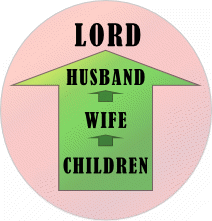
THIS pastor, however, seemed to completely ascribe to the literal translation of the first passage. He turned to the couple (for the purposes of this blog, let's refer them as "Lynette" and "Bob.") and said, "Yes, Bob, this means that you are in charge. Of course, Lynette, you can certainly have an opinion. Don't forget that, Bob. But in the end, Bob is the one whom God will hold accountable. The mantel of leadership has fallen on him and him alone."
So the hierarchy looks like this (and this is from an actual website that professes to be about partnership in parenting!)
This theology is particularly damaging in situations of verbal, physical, or sexual abuse. If a woman believes that her husband is her God-ordained ruler, then it follows that she's expected to obey and honor him as God's representative on earth. Now most theologians (even conservative evangelical theologians) would say that in the case of abuse, the husband is obviously not following God's law, and that the wife is thus released from her obligation of blind obedience.
However, this gets tricky. How neurotic it must feel to be a woman in this situation. Is he hitting me because he believes God needs to discipline me? Do I deserve to be yelled at because of my own sinful behavior? Maybe I brought this on myself. I should have been kinder. More supportive. I am the one who did wrong. He is merely correcting me.
This theology is downright harmful to women in very real, tangible ways. But I haven't even gotten to the low point of this sad, sad ceremony.
Just when I thought things couldn't get any worse, the pastor attempted to describe what it would be like when the happily-almost-married couple faced their maker f
"God will hold you accountable, Bob, for this marriage. Not you, Lynette, so you get off easy. I like to explain it this way. Your job, Lynette, is to duck when God's fist comes flying at Bob."
Violence, eternal damnation, and gendered submission. Can you imagine any better way to begin a lifelong relationship?
Posted by
Rebecca Lauren
at
2:32 PM
1 comments
Thursday, August 21, 2008
If I could turn back time...I wouldn't
Continuing with my recent segues using 80's/90's music, I decided to begin today's post with Cher's reminiscent single. Ah, don't we all often feel a certain wistfulness for days gone by. (Especially my dear mother, who tried to get in the front row of Cher's recent reunion tour...for real.)
I was listening to a radio program a few years ago on NPR. The guest speaker was discussing the state of American society. I can't remember if the topic was poverty or teenage pregnancy, but I remember that the man was hopeful toward our nation's possibilities.
When the announcer opened the lines for phone calls from listeners, one man called in and suggested that the solution lay in the past. That all we needed to do to solve our problems was to "turn back time" to an era when there were no drugs, no making out in front of the lockers at one's high school, no severe poverty. He was speaking of the 1950's.
I'll never forget the announcer's reply. He said (and I'm paraphrasing from memory here), "Oh yes, the perfect 1950's, when racism and sexism were still rampant and acceptable. Sure, your life as a middle class white man might have seemed perfect, but what about the rest of the population?" Then the guest speaker chimed in. "Yes, I agree. And I don't know about you, but there were still plenty of people at my school in the 1950's making out in front of lockers..."
Ha.
It's pretty clear to me that turning back time to a more Eden-like state of perfection does very little to move our society forward. Consider two recent books in the news that attempt to rewind American society: the re-emergence of the The Art of Kissing as a historical relic, and the new release of The Retrosexual.
In a recent article that appeared in Women's Enews, Kristen Tsetsi examines the ways that the seemingly innocuous language in this antique text mirror the language of date rape. (By the way, if you haven't done so already, consider subscribing to Women's Enews for free. A great resource for emailed news by and for women.) Consider just a few sample passages from Hugh Morris' 1935 book, The Art of Kissing:
"He must be the aggressor...He must always give the impression of being his woman's superior, both mentally and especially physically . . . He must be able to sweep her into his strong arms, tower over her . . . "
"If she flinches, don't worry. If she flinches and makes an outcry, don't worry. If she flinches, makes an outcry and tries to get up from the sofa, don't worry. Hold her, gently but firmly, and allay her fears with kind, reassuring words. Remember what Shakespeare said about a woman's 'No!'"
Ah, the old "no means yes" scenario. It's quite amazing to me that the genteel-seeming culture of the 1930's still presented quite a chauvinistic attitude.
And now for the second title: The Retrosexual. I don't think I could introduce this book any better than the London Mail:
"Once, men were simply men. But then feminists decided they were chauvinist pigs who didn't spend enough time doing the dishes. So along came the guilt-ridden New Man, swiftly followed by sensitive, moisturising Metrosexual Man. Of course, women soon missed the whiff of testosterone and were calling for the return of Real Men. Now a new book, The Retrosexual Manual: How To Be A Real Man, has been published."
A small selection of retrosexual tendencies:
1. Your mind is uncluttered. Consider the female brain, filled as it is with multiple anxieties about its owner's hair, figure, health, diet, clothes, shoes, emotions, digestive transit, sex life, competitive female friendships, multi-tasking duties as a worker/lover/ wife/mother/whatever.
Instead, your mind is focused on the important things in life: sex, beer, football. Women secretly envy a mind like that.
2. You can make decisions on your own. You don't need to talk it over for hours with all your friends, or consult a horoscope, or worry about feng shui.
3. You have strong arms which come in handy whenever bottles need opening, cases need carrying, or a girl just feels like gazing at a strong, muscular limb.
4. You do not clutter up the bathroom. No woman wants a man who owns more beauty products than she does. A man who showers, shaves, then gets out of the way is ideal.
The problem with books like these is that they assume that women's progress equals men's recession. In addition, they rely on our idealized version of the past and try to convince us that thing were better "back then." But were they?
Consider #2 on this list. Apparently men are not supposed to communicate with anyone about any big decisions. This is yet another example of a gender stereotype that harms us all.
Instead of turning back time, let's look ahead to a bright future, where men like my husband can use Herbal Essence hairspray with confidence, and women like me can belch at the dinner table. Who needs the rigid gender roles of the past when we can make our own, right Cher?
Posted by
Rebecca Lauren
at
5:21 AM
1 comments
Labels: language, literature, marriage, media
Wednesday, July 2, 2008
Man and Wife
My partner and I are wedding photographers, which makes it inevitable that I should write about gender disparity in the ultimate bastion of patriarchy in American society: the wedding ceremony.
This weekend, I heard a phrase that I hadn't heard in some time: I now pronounce you man and wife.
It took me back to the memorable scene in the Princess Bride Wedding.
Prince Humperdinck just can't wait for the priest to say those magic words, "man and wife." It will define his marriage to Buttercup. It will seal the deal.
So what's the problem with this time-honored sentence? It assigns men and women different and unequal realms. While it defines a man by his gender, it defines a woman by her role. Consequently, a man merely has to exist, while a wife must fulfill her duty in marriage. He is not required to act as a husband, but she is asked to act as a wife.
This language is important because it tells women that they are responsible for a marriage's success or failure. They are the ones who must serve, while the man is the one who must be served.
And while we're talking about language, the word "patriarchy" comes from the Greek words πατήρ, father, and αρχή, rule. Male authority can take many different forms. In the institution of the family, men have traditionally been given power over women in terms of property and ownership. Until the passage of the Married Women's Property Act of 1848, women relinquished ownership of all property on her wedding day to her husband. Thus, literally and figuratively, her husband "owned" her.
Today, patriarchy in the institution of marriage is less overt. We almost take for granted that children are automatically given their father's last name or that a man is still expected to "bring home the bacon," while a woman is expected to keep house. Still, these gendered expectations certainly affect our most intimate relationships. For instance, if a woman makes more money than her male spouse, should he feel inferior? If a man likes to cook or clean or do laundry, is he too "feminine"?
In my own home, I find myself falling prey to gender expectations like these. One example: I'm off for the summer, but my partner works. He likes to cook, and I don't. For him, cooking is relaxing, a creative outlet, an opportunity to try something new. For me, it's a chore. So who should cook dinner tonight? Can I remove all patriarchal influences when making that decision? Is the guilt that gnaws at me there because I don't have to work all day or because I feel like I should want to cook as a woman and don't?
It's tough stuff.
I like to look at the ending of the Princess Bride as an optimistic one. Check out the dialogue when Buttercup reveals to Westley that she's married Humperdinck:
Buttercup: Oh, Westley, will you ever forgive me?
Westley: What hideous sin have you committed lately?
Buttercup: I got married. I didn't want to. It all happened so fast.
Westley: It never happened.
Buttercup: What?
Westley: It never happened.
Buttercup: But it did. I was there. This old man said, "Man and wife."
Westley: Did you say, "I do"?
Buttercup: No. We sort of skipped that part.
Westley: Then you're not married. If you didn't say it, you didn't do it.
Ah, the power of language. Westley's right. Saying it is doing it. In my own commitment ceremony, we agreed to be "partners in life." The phrase evoked a kind of agency on both our parts, a commitment to serve each other.
Yet even so, I'm still not convinced that it's my turn to cook tonight. :)
Posted by
Rebecca Lauren
at
1:17 PM
0
comments