Well, the semester has kept me busy and away from blogging, but I can taste summer in the air, so here's to my second blogging wind!
Soooo, as I've mentioned a billion times before, I grew up as a feisty Christian, attending a giant Christian music festival every summer, serving as a Christian camp counselor, running my church youth group....you get the picture.
So when one of the best Christian artists of the early 00's, Jennifer Knapp, left the singing business quite abruptly in 2003, my curiosity was peaked.
For years, Christians have speculated about her departure. Was it family issues? Relationship problems? Was she losing her faith?
But above all, the question that continued to surface was, "Is she a lesbian"?
For those of you who did not grow up singing Kumbayah around the campfire, this seems to be the central concern of the Christian faith. Even worse, perhaps, than atheism is the idea that someone who professed Christianity would come out.
Well, come out she did! Seven years later, in an interview with Christianity Today.
Here's what I love about the article: the interview tries his darndest to get her to deal with her "struggle" in regard to homosexuality. Knapp refuses to acquiesce, instead calling into question the term "struggle" in the first place. She has this amazing ability to graciously allow her faith and her sexuality to co-exist.
She seems happy now -- content -- and authentically herself. And she'll be joining the re-vamped Lilith Fair tour this summer. She's not tortured or suicidal. She's not meek. She's just allowing herself to be who she is.
If only the rest of the Church could do that.
I'll leave you with just a few of my favorite passages that illustrate the honesty of Knapp's beautiful, prophetic spirit:
I'm in no way capable of leading a charge for some kind of activist movement. I'm just a normal human being who's dealing with normal everyday life scenarios. As a Christian, I'm doing that as best as I can. The heartbreaking thing to me is that we're all hopelessly deceived if we don't think that there are people within our churches, within our communities, who want to hold on to the person they love, whatever sex that may be, and hold on to their faith. It's a hard notion. It will be a struggle for those who are in a spot that they have to choose between one or the other. The struggle I've been through—and I don't know if I will ever be fully out of it—is feeling like I have to justify my faith or the decisions that I've made to choose to love who I choose to love.
I've always struggled as a Christian with various forms of external evidence that we are obligated to show that we are Christians. I've found no law that commands me in any way other than to love my neighbor as myself, and that love is the greatest commandment. At a certain point I find myself so handcuffed in my own faith by trying to get it right—to try and look like a Christian, to try to do the things that Christians should do, to be all of these things externally—to fake it until I get myself all handcuffed and tied up in knots as to what I was supposed to be doing there in the first place.
Yeah, Jennifer. Preach it, sister.
Wednesday, April 14, 2010
Former Christian Artist Jennifer Knapp Comes Out
Posted by
Rebecca Lauren
at
5:33 PM
1 comments
Monday, January 4, 2010
Mourning Mary Daly
Sometimes, we are reminded quite suddenly about the importance of life. Often, this realization comes in response to a great loss.
For the last two months, I have been bombarded by the typical demands of life -- running a business, wrapping up one semester, preparing for another, enjoying the hubbub of the holidays. All of these are good and important parts of who I am. But in the meantime, blogging about gender issues continued to take a back seat to these other responsibilities.
Then, this morning, I opened an email from one of my feminist listserves to discover that feminist theologian Mary Daly had passed away yesterday after two years of struggling with ailing health. Daly was one of those writers whom I felt I knew intimately; like if we had a chance meeting at a local coffee shop, we'd chat for hours over cups of chai. I feel like she cultivated this intimacy with many of her readers, and I believe it's largely because of the incredibly honest way that she explored her theological journey.
If you've never read her work, I recommend reading it chronologically. Start with The Church and the Second Sex, a text that seems woefully outdated to most contemporary feminist theologians, but is vital in understanding the groundwork laid by pioneers in religious feminist thought. In it, Daly is so seemingly innocent about her questions about theology and ecclesiastical hierarchy -- Why are all the priests men? Is the Virgin Mary an empowering figure to women or a limiting one? Why are women and men told that they have equal access to salvation, but then, according to the Catholic church, women have to get theirs through submission to men?
Then, as you progress through her later works, prepare to have your socks knocked off.
Move on to one of her most well-known works Beyond God the Father, where she questions the patriarchal nature of God. From there, perhaps indulge in the poetry of a new theology created in Gyn/Ecology or, one of my personal favorites, her witty dictionary of new feminist theological terms in Wickedary.
Daly is playful, subversive, and poetic. When I first encountered her writing, I did not know what to do with her. In fact, if you ascribe to traditional religious beliefs, her later works will probably make you uncomfortable. And rather fidgety. For me, they were kind of like the itch I couldn't scratch. For others, they generate anger and resistance. Here's why.
Daly begins her theological journey by trying to find ways to work within the traditional church, but she quickly determines that religious practices are too mired in the patriarchal nature of God (with a capital "G") for God's true egalitarian nature to be redeemed in any meaningful way for women. And while her spiritual journey and mine digress at this point (she rejects a patriarchal God; I try to rework my understandings of God so that they are non-patriarchal), I appreciate that her anger is honest and her questioning is real. I have encountered very few theologians who have achieved this level of prophetic bravery combined with an innovative intellectual pursuit of theology.
Daly has allowed me to analyze the patriarchal aspects of my belief systems, which in turn allowed me to reject those aspects that are harmful and uncover those aspects that are empowering to women and offer voice to the voiceless. I admire Daly and seek to emulate her unabashed desire for wholeness, community, and real love.
So today I honor Mary Daly's life, not, as is typical after someone's passing, because of fond memories or good deeds (both of which I'm sure exist in excess) but because of her rich intellectual life. Daly has reminded me, once again, at how powerful intellectual inquiry can be, how it can change lives through a never-before-articulated question, a well-worded rebuttal against the status quo, or, in Daly's case, an entirely new vocabulary to mirror an entirely new way of thinking.
The next time I put blogging or research on the backburner of my life, I'll think of Daly. She has taught me in earnest that the mind is a terrible thing to waste.
From Mary Hunt, in her brief memorial to Daly from Feminist Studies in Religion:
She created intellectual space; she set the bar high. Even those who disagreed with her are in her debt for the challenges she offered.
May we all strive for such a rich legacy of ideas.
Posted by
Rebecca Lauren
at
11:48 AM
5
comments
Labels: arts, language, literature, religion, traditions
Wednesday, September 16, 2009
Apparently feminism is evil.
Their motto is "extolling femininity, blasting feminism," and this group of conservative Christians is pretty angry at women, such as Hillary Rodham Clinton, who serve in leadership roles. Their also angry at women who work outside the home, choose to have no children (or maybe only just one), and serve in the military. Check out the trailer for their recent documentary on the subject. It will make your toes curl.
Here's just a clip about women in politics:
Of course, the documentary was directed and produced by two men, although there was one female writer on staff. She wrote with her husband, though, which means she was likely under his creative dominion.
I understand the draw of this perspective. It is comforting to organize the world in categories, easy to say that everything is black and white. If you are male, you have one set of characteristics. If you are female, you have another set entirely. If you stick to the script, you've got it made.
The problem is that a lot of us can't stick to the script and don't want to. I know many women with the gift of leadership, courage, boldness, and self-sufficiency, all attributes that are typically ascribed to men. I also know plenty of men who are emotional, humble, empathetic, and relational, all attributes that are typically ascribed to women.
When we deny ourselves half of the characteristics available to us, we deny ourselves a fuller humanity. So while I understand where this worldview comes from, I have to opt for a more uncomfortable perspective of humanity, one that says that men and women are quite complex beings, created with incredible potential but without a clear prescription of roles or behaviors.
Of course, this means that I don't always have the quick, easy, black and white answer. That's why I keep a blog...to write my way into meaning, to explore the paradox of our lives, to embrace the gray.
Posted by
Rebecca Lauren
at
4:28 AM
3
comments
Wednesday, August 26, 2009
Ciao, Bella.
Today is Women's Equality Day, established by former Congresswoman Bella Savitsky Abzug, who was perhaps most known for saying: This woman's place is in the house -- The House of Representatives.
Unfortunatley, Abzug passed away in 1998, nine years before Nancy Pelosi would become the first female Speaker of the House. I bet she would have been thrilled at how far women have come.
But we have a long way to go. Check out the Center for American Women and Politics maps, illustrating how often women have served on the State Legislature, in Congress, or as Governor.
We may think that we are the model nation in terms of gender equality, but new research shows the following:
One important way to measure gender equality is to see the proportion of women in a country’s legislature or parliament, according to the authors. By that measure, as of 2005 the United States ranked 61st of 128 countries, with 15.2 percent women in Congress. Rwanda leads the world with 48.8 percent women in its parliament.
Overall, the International Women's Day site states that "Although women make up 51 percent of the world’s population, they hold only 16 percent of parliamentary and congressional seats worldwide."
Bella Savitsky Abzug challenges us with a legacy of female empowerment in regard to the political representation of women. But often, we find ourselves asking, "Where do we begin?"
I find it particularly interesting (and perhaps comforting) that Abzug's feminist journey began with a small local act of resistance. In fact, it took root when Abzug was only 12 years old in the questioning of patriarchal religious tradition. When her father died, she wanted to say Kaddish at his funeral, an honor only reserved for sons in her Orthodox Jewish community. She resisted, and continued to practice these daily mourning prayers. Later she said this:
No one could have stopped me from performing the duty traditionally reserved for a son, from honoring the man who had taught me to love peace, who had educated me in Jewish values. So it was lucky that no one ever tried.
On this Women's Equality Day, may we be open to creating moments of small resistance. Maybe one day, our struggles within our individual "house" of residence or worship might become, as Abzug's did, our struggles within the national "House."
Posted by
Rebecca Lauren
at
3:14 PM
0
comments
Labels: international gender lens, politics, religion
Tuesday, July 21, 2009
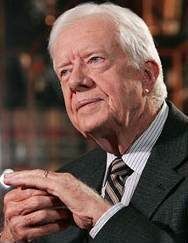
Jimmy Carter offers a prophetic gender lens into the Sothern Baptist Church
After 60 years of being active in the Southern Baptist Convention (and by active, I mean teaching Sunday School, serving as a leader in his congregation, etc.), Jimmy Carter has broken all ties with his denomination because of their continued attempts to twist scriptures into advocating the subjugation of women.
While I will quote some of the passages of his essay here, I highly recommend reading the whole thing. It is written in so lovingly that you can sense the pain in Carter's decision. He's leaving friends here, in addition to a faith community and a doctrine that has buoyed him for most of his life.
But he's doing it because of his faith in a just God. I'm incredibly touched (as are many other women) by Carter's clarity on these issues -- the way he illustrates a direct cause and effect between gender discrimination in the church and the resulting realities of women and girls around the world:
At its most repugnant, the belief that women must be subjugated to the wishes of men excuses slavery, violence, forced prostitution, genital mutilation and national laws that omit rape as a crime. But it also costs many millions of girls and women control over their own bodies and lives, and continues to deny them fair access to education, health, employment and influence within their own communities.
...The same discriminatory thinking lies behind the continuing gender gap in pay and why there are still so few women in office in the West. The root of this prejudice lies deep in our histories, but its impact is felt every day. It is not women and girls alone who suffer. It damages all of us.
One of the reasons that Carter is able to challenge his own long-held belief system seems to be because of a supportive group of religious leaders called the Elders, a group selected by Nelson Mandela "who offer their influence and experience to support peace building, help address major causes of human suffering and promote the shared interests of humanity." It is this group that issued the statement that "The justification of discrimination against women and girls on grounds of religion or tradition, as if it were prescribed by a Higher Authority, is unacceptable."When I teach young women who come from similar backgrounds as Carter, they tell me story after story about the mixed messages they receive growing up. One student said that her parents encouraged her to be anything -- even the President -- in the public world, but cautioned her against speaking too loudly in church or becoming a pastor.
My sister-in-law began to tell my aunt about her new job in her church. My aunt asked pointedly, "Oh, are you working in the church office or with the children?" as if those were the only two options available to a woman.
I've known of many women who aspire to be "a pastor's wife," when they would really be incredible pastors themselves.
And I've known countless other women whose suffering from the church is more nuanced. Perhaps, like me, they had a hard time speaking up in a classroom. Perhaps they came to see their female bodies as sinful, the very source of Eve's betrayal. Perhaps they learned to keep quiet when they really wanted to speak their minds, or served as peacemakers to their male counterparts, to stayed in the kitchen while the men participated in the "real" work of the church. Perhaps they learned to see God as male, and male as good. Perhaps they've never been able to fully accept themselves as good in their femaleness. The list goes on and on.
But like Carter, I've found that those who have been wounded by the church often find solace in supportive community. Ironically and unfortunately, this kind of community is often found outside the church instead of inside. If more church leaders, like Carter, learn to speak truth to power, maybe this will change.
I'll leave you with Carter's own words:
The truth is that male religious leaders have had - and still have - an option to interpret holy teachings either to exalt or subjugate women. They have, for their own selfish ends, overwhelmingly chosen the latter. Their continuing choice provides the foundation or justification for much of the pervasive persecution and abuse of women throughout the world. This is in clear violation not just of the Universal Declaration of Human Rights but also the teachings of Jesus Christ, the Apostle Paul, Moses and the prophets, Muhammad, and founders of other great religions - all of whom have called for proper and equitable treatment of all the children of God. It is time we had the courage to challenge these views.
Posted by
Rebecca Lauren
at
5:35 AM
4
comments
Labels: religion
Tuesday, March 10, 2009
The most important day of your life
...is, according to a new book, your wedding day. Ah yes, it's not the the day you earned your degree, that vacation in Italy you'd dreamed of taking your whole life, or the birth of your favorite niece. It's the day in which many women still vow to obey their husbands.
I won't even begin to rant about how heterosexist this whole thing is, or how it relies upon the idea of biologically-inherited gender roles. Why can't a person of faith give us all a book about how to be better partners? In general? Regardless of gender or sexuality?
Sigh...
I will rant (albeit briefly) about how ridiculous it is that apparently a male author knows best about what you need to know about becoming a "godly wife."
It's ridiculous.
(That's my rant.)
But fear not! There's also an edition custom made for the new groom! Because, according to the product description on amazon.com "As the soon-to-be spiritual leader of a new family it's important that a man of faith establishes a firm foundation on which his family will be built."
...because apparently women can't be expected to be spiritual leaders.But hey, at least it's fashionable: "The elegant black tuxedo stripe LeatherSoft binding makes this Bible the perfect gift for any groom who wants a firm footing as he journeys down the path to marriage!"
I guess that's the secret of marriage I've been missing all these years. If only I had a Bible for brides, I'd really know how to make my husband happy.
And my happiness? Not a problem. At least I'd get the chance to experience the most important day of my life. Who cares about what comes next? All I need is one day of bliss. The rest is downhill from here anyway, right?
Posted by
Rebecca Lauren
at
3:37 PM
0
comments
Labels: literature, marriage, religion
Wednesday, March 4, 2009
Feminism and faith
In the context of Western religion, these are not two terms that one often sees together. In fact, much of my life, I have heard one side criticizing the other. But as you'll see in some of my previous posts, I pronounce this perceived paradox proudly. (How's that for alliteration??)
I'm also an eternal optimist, which may explain why I believe that more and more folks on both sides of these labels are reaching across to the other side. Take, for instance, publications like Harvard's Journal of Feminist Studies in Religion, which covers this emerging dialogue between feminist theory and theology. (And if you check out this magnificent publication, be sure to check out the Fall 2008 issue to read one of my poems, which is published there!)
Or, in the realm of popular culture, Sue Monk Kidd's memoir (before her Secret Life of Bees fame), The Dance of the Dissident Daughter, where she explores the dance between her Christian self and her feminist self.
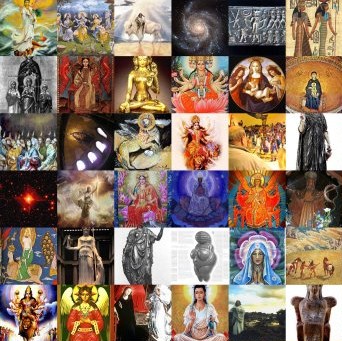
Of course we're all aware (and perhaps a little tired of) the Da Vinci Code's rise to fame, but I think the importance of its popularity lies in the fact that it reflects an ongoing cultural desire for the divine feminine.
I speak from my own Protestant perspective when I say that we've lost that particular image of God. Despite biblical evidence to the contrary (God portrayed as a hen gathering her eggs, a midwife birthing a child, etc.), we've often chosen to see God exclusively as father. This is detrimental to women in so many ways. First, we learn that God is the best, and if God is male, then male is the best. (Mary Daly famously wrote in the seventies that "If God is male, then the male is God.") Second, we tend to identify God as being the same kind of father as our earthly father, which is not always a positive image for women. Sometimes our fathers abandon us, abuse us, or tell us we're never good enough. Finally, it is extremely limiting to see God as embodying only one half of the human race.
But again, the eternal optimist in me begs to speak. One sign of improvement in the feminism/faith dichotomy is a program at which I have the pleasure of teaching every other May. The Oregon Extension Women's Studies May Term allows college students the opportunity to explore the intersection of faith and feminism through academic discourse, journaling, and creative projects. It's the place where I learned to embrace this seeming paradox within myself many years ago as a college student.
This year, we have so many applicants to the program that we may need to begin a waiting list. It seems undeniable that the dialogue about feminism and faith lives on.
I don't usually use this blog to elicit donations, but many of our applicants are in need of financial aid in this economic climate. If you believe in this important conversation, please consider donating to our scholarship fund by clicking on the "Donate Now" button at www.oemayterm.org It's tax-deductible, and your contribution may allow a student the freedom to call herself "feminist" and "faithful" for the first time without fearing the wrath of God.
Sunday, October 26, 2008
Mamas, Llamas, and Votes
Today, our politically active church did not let us forget the fact that next week is election week. In fact, even the children's sermon was full of non-partisan political initiative.
Now, I'm used to children's sermons that consist of a brief object lesson involving a shoebox or a light bulb or a candy cane. In each case, all I knew as a kid was that the correct answer to any question was "Jesus."
But not so at my current church. Here, the children's sermon is usually one of the most moving portions of the service. These kids make you think. They make you reconsider the seeming simplicity of your faith.
So today, instead of the Ten Commandments or why we shouldn't tell a lie, the children's talk was about the complex history of women's suffrage.
There were several powerful moments in this short little conversation with the kids.
The first came when our pastor asked how many people in the congregation had a mother who was of voting age pre-1920 and consequently encountered a time in her life when she wasn't able to vote. Several hands shot up. Then, she asked how many people had a grandmother who was unable to vote. Nearly 3/4 of the hands went up.
It had never occurred to me how recent the suffrage movement really was until that moment. Suddenly, it became no longer some removed historical fact.
We're talking only a couple of generations ago. It's hard to imagine.
The second great moment of the children's sermon occurred when our pastor asked the kids why they thought women weren't allowed to vote back then. Our usually precocious kids didn't raise their hands. They had no guesses. They were stumped.
"Actually," Pastor Laurie said, "I'm glad you don't have an answer to that one. There were no good reasons that women weren't allowed to vote."
The congregation chuckled. We were proud of our kids. We realized that they've grown up in a world that has never told them that their gender is too uneducated, too weak, or too frivolous to vote.
I left church feeling even more driven to exercise my right to vote this election. And this led to an embarrassingly obsessive t-shirt buying frenzy. (Perhaps not the most politically-transformative way to get the word out, but nonetheless, it was fun.)
First, I got the following shirts for my mom and mother-in-law:
Then, I had to treat myself to the following:
The latter really has nothing to do with gender issues, but I've been trying to figure out how to incorporate llamas onto this blog for some time, and this is the best I can do. I mean, honestly, how could you refuse to vote for Obama when you've got this fuzzy, weird-looking creature egging you on?
Plus, who could resist the llama song?
In fact, with a few minor alterations, this could end up being our new National Anthem:
Regardless of whom you vote for, may we all remember that, unlike llamas, we as women do have the right to vote. And that's a relatively new and wonderful freedom.
Posted by
Rebecca Lauren
at
7:10 PM
0
comments
Thursday, October 16, 2008
Why I'm Anti-Abortion and Pro-Choice
I've tried to keep political commentary on this blog to a minimum, not because I don't think politics are important, but more because I DO think politics are important. As you can tell from my earlier post, our participation in selecting our government leaders is a right that is to be taken seriously.
Yet as we near Election Day, partisanship causes us to become more divided and, well, more ruthless to one another.
We become polarized on many issues because they are beliefs held close to our hearts. Yet despite the negative campaign ads and political bickering, there's one issue that we just might be less divided on than usual -- abortion.
As a person of faith and a feminist, this issue has threatened to polarize me against myself. Yet both of these aspects of my identity offer me gifts of wisdom and justice.
My faith encourages me to work for life during my time on this earth -- life for unborn children, Iraqi civilians, men and women with AIDS, malnourished kids, etc. My identity as a feminist
offers me the opportunity to fight for choice -- the choice to have children or not have children, the choice to get an education, the choice to receive equal pay for equal work, the choice to live my dreams.
So for a long time now, I've been uncertain as to which camp I fall under: Pro-life or Pro-choice. I'm both.
This year, I began to say it this way: I'm anti-abortion and pro-choice.
At the debate last night, Obama echoed my sentiments, saying that no one was pro-abortion, and I think this is definitely getting closer to the mindset that many of us hold.
In a recent blog from the progressive Christian magazine Sojourners, Jim Wallis agrees:
Last evening, both Barack Obama and John McCain took steps toward finding some possible common ground.
Both said that they would not use Roe v. Wade as a litmus test for appointing Supreme Court Justices in the future.
And both suggested some cultural commitments and policy directions that could be most effective in dramatically reducing abortion. Last night’s debate got that conversation started.
Americans are for life. Americans are for choice. The challenge for our political leaders, our religious leaders, and every American is to hold freedom and life together even when they seem to collide. We should do all we can to make sure we have as much of both as possible. And we can start by having a better conversation about abortion in this election and beyond. Thankfully, the first steps toward that conversation were taken last evening.We still have a long way to go on both sides of this issue, but last night gave me hope that we will realize that polarization doesn't solve anything. Listening does. Dialogue does. Understanding and compassion certainly do.
I've often commented to my partner that the political system in this country would be so much easier if we continued to follow the election principles that the U.S. was founded upon. Remember from elementary school history class? Whoever received the most votes became President. Whoever received the second-most votes became Vice President.
Call me a forever optimist, but can you even imagine the reconciliation that might take place in this country if we worked together? Instead of a battle of rhetoric between Pro-choice and Pro-life camps, we might actually put our heads together and think of a better way to help women with unwanted pregnancies.
Unfortunately, the two-party system seems here to stay. The best we can do now is put aside our own binaries and instead try to live in paradox.
Posted by
Rebecca Lauren
at
6:41 PM
1 comments
Sunday, September 28, 2008
A shout out to my wonderfully unconventional youth group
Generally, when I hear the words "youth group," what comes to mind is lots of Kumbayaa-ing around a fire pit, a series of nonsensical group games involving whipped cream and paper bags, and a lesson that inevitably leads us all to repent of our weekly failings and draw closer to God.
So when my church asked Joe and I if we'd be youth group leaders, I had to seriously pause.
My parents were my youth group leaders when I was growing up, and they were always full of energy and earnest about their roles.
But in this era of postfeminist thinking, I had to re-evaluate what my approach youth group might look like. I decided that I'm anti-indoctrination, anti-God-as-father-but-not-as-mother, anti-religion-as-excuse-to-sit-back-and-wait-for-heaven, etc. You get the picture. So what's a feminist youth group leader to do?
Fortunately, I'd found this superbly crazy church family at Central Baptist Church, so I had nothing to worry about. (Don't let the Baptist fool you -- these guys and gals are into social justice, changing the world, serving the poor, welcoming the LGBT community, etc.)
At this weekend's annual youth retreat, we had the requisite group games and singing, but we also journaled, played with modeling clay, made up rhythmic chants as prayers, and painted.
My favorite activity this weekend came when one of the leaders asked the youth to create a craft project that reminded them of God. One kid drew an awesome picture of a muscular guy with tattoos. "I think God sits on a big couch up there with a high-def TV, making sure we're all doing alright," he said.
When someone asked him about God's tattoos, this kid said matter-of-factly, "Oh, isn't it obvious? God's been in the Navy."
I cracked up.
Then, another youth member said that God, to her, was a woman.
The kid sitting next to me read me his "Letter to God." It said:
God, please watch over us. You are a light saber. May the force be with you.Another made a banner out of purple glitter that said "God is da bomb."
Unconventional? You bet. But what's wonderful about these youth is that they view God as this great creative being, as one who lives beyond rigid gender roles and can be man, woman, light saber and purple glitter all at the same time.
In short, I love each and every one of these youth for their quirky creativity. I love that they are all reflections of a God that I can believe in -- one who is full of love, joy, and endless, genderless possibilities.
Friday, September 5, 2008
Oprah: Feminist Theologian??

This past weekend, a small sliver of a dream came true for me. I got the chance to see Oprah.
No, I didn't land free tickets to her show or open my front door in my jammies to see her camera crew there waiting to whisk me off to Neverland.
Instead, my partner and I went to hear her speak in Steadman's hometown of Whitesboro, NJ to a small crowd of 500 people. (In fact, all pics in this entry are c/o my partner Joe You rock, babe.)
And she was everything I hoped she'd be: confident, funny, motivating, emotionally moving, and theological.
Yes, theological. And not only that, her stories reflected a theology that empowered women, something we don't always encounter in churches these days.
Oprah told the story of how she had auditioned for the movie The Color Purple and then heard nothing about the part for weeks. She couldn't remember wanting anything more.
Then Joan Rivers called her "fat" on national television, and Oprah vowed to visit a fat camp. She was running on the track, feeling sorry for herself, when she realized that she needed to "give everything to God," the movie role, her anxiety over it...everything.
As she walked off the track, she felt relieved.
Just then, a woman in a purple coat came running towards her, telling her that Steven Spielberg was on the phone. She'd gotten the part.
Now, this post is not meant to be a lesson in prosperity theology. Instead, what I found interesting in Oprah's talk were the ways that she reclaimed religious language in an almost feminist way.
I expected her to sermonize about how important it is that we [as women] give up control of our lives to God. This is a fairly typical viewpoint in Christian theology. In fact, there are numerous worship songs that are popular in churches today with lines like "less of me; more of You," "I decrease so He increases," etc.
The problem with this theology, particularly for women, is that it encourages us to literally become less of ourselves. For some women, this can manifest itself, quite literally, in anorexia. For others, it appears in a quiet meekness, a hesitancy about ourselves, an overall lack of self-confidence, or worse, a deep manifestation of self-loathing.
In truth, if we become nothing, we remain nothing. God is a God who works through responsive, active human beings. Consequently, I believe that when we become more of our true selves, we embrace God's transformational power. When we love ourselves, we are able to love others. When we love what God has created in us, we are more able to create positive change in the world.
And this is essentially what Oprah told the crowd. When she let go of the Color Purple role and gave it up to God, she was saying, "I've done my part. Now it is up to the universe." She didn't say, "I became nothing, so that God could be something."
She didn't discredit the importance of her own agency in this process. In fact, she said that she never would have gotten the part had she not practiced, auditioned, and made the follow-up phone call.
This is so different from the author friend of mine, who, when she got offered an incredible 2-book deal from her publisher said to me, "Well, I didn't do anything. It was all God."
Now let me be clear. I'm not against giving God credit. I just think it's important that we, as women, recognize the vital importance of our human agency in creating positive change in the world.
Oprah puts it this way: "Every morning, I pray that God will show me how I can do something greater than myself."
Posted by
Rebecca Lauren
at
11:57 AM
0
comments
Labels: language, media, religion, television
Tuesday, August 26, 2008
Patriarchal Weddings: a low point
As I mentioned before, my partner and I shoot a lot of weddings, especially this time of year. The institution of marriage is a topic of great contention for feminists. With gay marriage still illegal in most states, some feminists have decided to eschew the institution itself, believing that it was created as a patriarchal structure of power, which cannot be redeemed. Moreover, it excludes a large portion of America's population: gays and lesbians in committed relationships.Laws Regarding Same-Sex Partnerships in the United States
██ Same-sex marriages
██ Unions granting rights similar to marriage
██ Unions granting limited/enumerated rights
██ Foreign same-sex marriages recognized
██ Statute bans same-sex marriage
██ Constitution bans same-sex marriage
██ Constitution bans same-sex marriage and other kinds of same-sex unions
Other feminists have attempted to transform the system of marriage into something more egalitarian and innovative. Consequently, my partner and I have participated in ceremonies where couples write their own vows, invent their own liturgies, and dispose of traditions that seem to devalue women's autonomy. One couple walked a labyrinth to signify their commitment to one another. Others light the unity candle, but refuse to blow out their individual
scri
Yet this past weekend included NONE of the above. In fact, I think the ceremony was more entrenched in patriarchy than any I'd ever participated in before. The pastor quoted the following passage from Ephesians:
"Wives, submit to your husbands as to the Lord. For the husband is the head of the wife as Christ is the head of the church, his body, of which he is the Savior. Now as the church submits to Christ, so also wives should submit to their husbands in everything."
As a person who ascribes to the Christian faith, I can't say this is my favorite passage in the Bible. In fact, truth be told, I rather despise it. However, the following verse, which this particular pastor conveniently glossed over, asks for mutual submission in a relationship:
"Husbands, love your wives, just as Christ loved the church and gave himself up for her"
Sacrifice is required in both roles, which is how I've most frequently heard this passage interpreted. (Of course, there is still some inherent patriarchy in these verses, but my own personal theory of feminist biblical exegesis will have to wait for another post...or another master's dissertation.)
THIS pastor, however, seemed to completely ascribe to the literal translation of the first passage. He turned to the couple (for the purposes of this blog, let's refer them as "Lynette" and "Bob.") and said, "Yes, Bob, this means that you are in charge. Of course, Lynette, you can certainly have an opinion. Don't forget that, Bob. But in the end, Bob is the one whom God will hold accountable. The mantel of leadership has fallen on him and him alone."
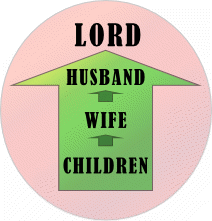
So the hierarchy looks like this (and this is from an actual website that professes to be about partnership in parenting!)
This theology is particularly damaging in situations of verbal, physical, or sexual abuse. If a woman believes that her husband is her God-ordained ruler, then it follows that she's expected to obey and honor him as God's representative on earth. Now most theologians (even conservative evangelical theologians) would say that in the case of abuse, the husband is obviously not following God's law, and that the wife is thus released from her obligation of blind obedience.
However, this gets tricky. How neurotic it must feel to be a woman in this situation. Is he hitting me because he believes God needs to discipline me? Do I deserve to be yelled at because of my own sinful behavior? Maybe I brought this on myself. I should have been kinder. More supportive. I am the one who did wrong. He is merely correcting me.
This theology is downright harmful to women in very real, tangible ways. But I haven't even gotten to the low point of this sad, sad ceremony.
Just when I thought things couldn't get any worse, the pastor attempted to describe what it would be like when the happily-almost-married couple faced their maker f
"God will hold you accountable, Bob, for this marriage. Not you, Lynette, so you get off easy. I like to explain it this way. Your job, Lynette, is to duck when God's fist comes flying at Bob."
Violence, eternal damnation, and gendered submission. Can you imagine any better way to begin a lifelong relationship?
Posted by
Rebecca Lauren
at
2:32 PM
1 comments
Wednesday, July 23, 2008
Feminist Monks?
I've just returned from a brief stay at Holy Cross Monastery, located near Poughkeepsie, NY, where I worked intensely on poetry and reflection. I traveled there by train with my good friend, The Creek Hiker. The monastery was on a hill overlooking the Hudson River. You could walk down to the river and just think, or walk up the hill to a labyrinth made of stones. The monks were so gracious. We went to worship with them several times a day. They sang entire Psalms, and it was just one of the most beautiful sounds I've ever heard.
So one might ask why a feminist might find solace with a group of men, yet that is exactly what happened during my stay at Holy Cross. There seems to be a general misconception in the public mind that feminisim = man-hating. This cannot be further from the truth for the vastmajority of feminists.
While there are many different versions of feminism, most feminists are fighting against patriarchy, a structure of power that traditionally oppresses women. This structure tends to put men in power and offer them privilege. My goal, then, as a feminist, is to deconstruct patriarchy, to unpack the ways that it harms both women and men.
Patriarchy harms us all, regardless of gender. A wonderful, whimsical illustration of patriarchy is the book Hope for the Flowers. Here, Trina Paulus presents us with the life of two caterpillars, Stripe and Yellow, who try to fulfill their instinct to "move up" in the world. They join thousands of other caterpillars in a giant "caterpillar pillar," a mass of little bodies climbing on top of each other to the great unknown above. Soon, Yellow becomes disconcerted with this effort, uncomfortable at the prospect of having to step on someone else's head to move forward in the world. She begins the long crawl down, abandoning this patriarchal structure for something better.
Yellow learns to fly, and in doing so, to "move up" in the world in a way that empowers others instead of disempowering them. This, too, is what most feminists aim for: a new way of doing things. A new way to reach the sky without stepping on a fellow caterpillar in the process. A butterfly way of being.
It is this kind of deconstructing that I found in the monks. Note their non-patriarchal Vision and Core Values:
*To personally and communally live a more authentic witness of Benedictine Ideals (namely pax or "peace," and ora et labora or "prayer and work" in the Contemporary World.
*To consciously develop and practice the attitudes and skills necessary to genuinely Listen and Respond to each other and our world.
*To face the power we hold to act on behalf of justice and to use that power, individually and corporately, for the sake of justice.
*To Welcome Diversity that enriches our life and mission and to embrace the costs and benefits that results.
It almost sounds like a feminist platform.
Yet you'll notice in my previous post that I referred to my father as "pro-feminist," not a "feminist." In the same way, I would ascertain that the monks at Holy Cross certainly seem to embody many feminist principles, but as men, they don't embody feminism. They can't, anymore than I can embody the experience of an African American. But they can certainly participate earnestly in the cause to eradicate patriarchal forces. And they do.
Perhaps my favorite inkling of resistance came during Vespers one evening. In the prayer book, I noticed that several newly typed prayers were scotch taped over the previous prayers. When I lifted the corner of one, I realized that the new prayer referred to God as "you" instead of "him."
What a beautiful way to deconstruct authority. In that quiet moment, with the monks singing Psalms in a small cathedral, I almost felt like Yellow. I could let go of the caterpillar pillar of religion within me. I could fly.
Posted by
Rebecca Lauren
at
8:45 AM
0
comments