Check out Jezebel's list of the Top 20 Feminist TV Characters of All Time.
A little on their commonalities (that reflect mainstream American feminism's ongoing race and class biases):
In doing research for this, we noticed that a lot of these women had characteristics in common. Almost all of them are middle class. Many of them are educated and somewhat socially awkward. A lot of them are either nerdy, or have nerdy pasts, and can be annoying. But unfortunately, all of them — including the animated ones — are Caucasian. Worse still, only three of the females listed below are characters on shows currently on air. It's sad that in the past 30 years, feminism hasn't even managed to get two dozen recurring characters on television to admit to being part of the movement.
It's also important to note that their criteria for this list is that the characters "openly flew their feminist flags," i.e. they're not just looking for strong women here. They're looking for women who "spoke openly about being feminists or feminism."
Who do you think should or shouldn't have made the list? I'm a little shaky on the choice of Jessie from Saved by the Bell...
Saturday, August 15, 2009
Just in case you thought the media was entirely anti-feminist...
Posted by
Rebecca Lauren
at
6:13 PM
2
comments
Labels: media, television
Sunday, April 19, 2009
Why we love Susan Boyle (from a feminist perspective)
If you've seen this video posted on everyone's Facebook page, tweeted about on Twitter, and watched thousands of times on Youtube but just assumed it was another American Idolesque fad, you couldn't be more wrong.
I've now viewed it four times, and each time, I burst into tears. I thought it was just me, but then I showed my rather stoic partner, Joe, and he, too, burst into tears. In fact, he promptly watched it through a second time and then pulled out our Les Mis soundtrack and declared that Susan Boyle's version was better.
So what is it that gets us about this woman? I mean, the whole world seems incredibly moved and affected by Boyle's performance.
While Simon Cowell and the other judges touched on it a bit, I think they need the aid of a gender lens to truly understand what all the hype is about. It's not just that Boyle appeared frumpy, nervous, and goofy before pulling off a sincerely moving performance; it's that she defies our expectations of an acceptable female singer. Namely, she's shown that good looks are not a requisite for the presence of a good voice.I would venture to say that most of the audience -- me included -- assumed that an older gray-haired woman with bushy eyebrows, dressed in a faded housedress, could not have a decent voice. I don't think we hold men to nearly the same standards. (Consider, for instance, gray-haired Taylor Hicks or overweight Ruben Studdard, both American Idol winners.)
In fact, we frequently offer disdain to female performers who do not match our society's stereotypes in terms of female beauty and body image. Think of Queen Latifah, once celebrated for her curvaceous vivaciousness, now spokeswoman for Jenny Craig. Marie Osmond is spokeswoman for Nutrisystem, and Wynonna Judd is the celebrity representative for Alli, a weight-loss drug. Over and over again, the message seems to be that female performers are not acceptable if they are not skinny, wrinkle free, and flawless.
Susan Boyle defies that image, and she does so with a lovable quirkiness and confidence. And now that record companies are knocking at her door, my only prayer is that she does not give in to the pressure to conform. I want her to grace her first album cover, wrinkles and all, with her gray hair wisping in every direction and her housedress clinging to her sides. I want this woman to continue to show us that look aren't everything and that regardless of what society tells us, we can dream any dream we darn well please.
Posted by
Rebecca Lauren
at
2:45 PM
4
comments
Labels: arts, body image, fashion, media, television, weight loss
Sunday, February 22, 2009
Oscars? Yup, still a boys' club.
The fact that the award itself is named after a man should tell us something, but many of us will still crowd in front of our television sets this evening and tell ourselves that this is a fair, unbiased representation of the best acting/directing/producing/artistic talent in the movie world.
However, when we polish our lil gender lenses, we'll find that this just is not the case.
Consider, for instance, what Melissa Silverstein of the Huffington Post points out (and this is just a sample):
-None of the Best Films Feature a Woman as the Lead
-Directing is Still a Boy's Club
-Women of Color Dominate the Supporting Actress Category Congrats to Viola Davis (Doubt), Penelope Cruz (Vicky Cristina Barcelona), Taraji P. Henson (The Curious Case of Benjamin Button). The best actress category is white and not a single of the male acting nominees are of color.
-A Woman Still Has Never Been Nominated for Best Cinematography
Hesse also points out that "the only categories in which women have more nominees than men are Best Actress and Best Supporting Actress."
I also have to recommend Monica Hesse's piece in the Washington Post, which asks, among other things, why we have a gendered Best Actor / Best Actress category in the first place. She also quotes the following 2008 study from the University of Southern California:
The study evaluated nearly 7,000 speaking roles in recent Oscar-nominated movies, finding that only 27 percent of those roles belonged to women. In films with female directors, however, the percentage jumped to 44 percent.
As I'm munching on popcorn and soft pretzels with friends, I'll be pondering the gender inequity of tonight's events while cheering on my favorite nominees. It's tough to do both at the same time, I admit. But alas, this is the plight of a feminist movie fan, is it not?
Posted by
Rebecca Lauren
at
2:28 PM
0
comments
Labels: arts, media, movies, television
Tuesday, January 27, 2009
Top Chef? Or Top Chauvenist?
Add in a pinch of sexism and a dab of meritocracy, and what do you get? An interesting impromptu Facebook conversation about Bravo's hit reality TV show, Top Chef.
A little background info: Stefan is one of the remaining contenders. He seems to be a good cook, but he's quite full of himself, and no one wants to work with him because his attitude is horrible. I've been rooting against him just about every episode, but last week, when the freezer broke and he was supposed to make a frozen dessert, I marveled at the fact that he figured out a way to make it work. I thought this was innovation. My friend, CR, however, thought this was a sure marker of privilege.
Here are bits of our conversation (admittedly rushed, off-the-cuff, and written in haste as we both tried to avoid grading papers)...
CR:I wouldn't care if Stefan managed to freeze that dessert by holding individual ice cubes up to it for 4 hours straight. Ugh. Ugh. I happen to think a lot of that "find a way to make it work" mentality is all about growing up with privileges that lead you to believe that you can do and be anything you want. I think that is why we see it much more often in men than women. I don't know Stephan's background (beyond being white and male), but I'd be willing to bet that he is middle class or upper class. Put all those things together and the world is much less likely to tell you that you can't do things.
RL: Fascinating insight, but I could argue the complete opposite. I mean, doesn't growing up with little mean that you have to be innovative to make the best of it? Some of the best recipes come when there is nothing in the house, and you have to figure out what to do with what is left. So, having less means that you are forced to be more creative. You say that being a WASP means that "the world is much less likely to tell you that you can't do things," but doesn't that mean that you also never have anyone challenging you? If people always like what you have to offer, then where is the motivation to get better? And you have to admit, Stefan is a decent chef. I just hate his attitude. I mean, the show isn't judging him on whether or not he's a selfish pig. They're judging him on how he cooks. And the man can cook.
CR: I do agree that he seems to be a good chef. I will also say, though, that the show has a history of what I see as sexism and classism. It seems very much like the judges have an idea of who they think deserves to win from the very beginning. Then there were the comments at the end of last season when the win of a woman (the first one to get so close!) who consistently made really good food was downplayed because "it was Richard's to lose" rather than hers to win. I don't know, but that spoke volumes to me. Her food was good; she proved it over and over again, yet it wasn't hers to win but someone else's to lose. Someone else who also made good food but far less consistently. Of course, the show is scripted to a certain degree, and choices are no doubt influenced by producers who are trying to keep the drama going. I guess what I'm getting at here is that I think Stefan has an advantage -- one that does not rest on merit.
And I see what you are saying about having to be creative, but that's really different than what happens on the show. Making a meal for 5 with nothing but rice, a can of pickled beets, and processed cheese is one thing. It requires invention and creativity, but historically I don't think that kind of creativity has been nearly as heralded as, say, making some kind of gourmet food with all sorts of unlimited resources.
I also see *having* to be creative as different than growing up with a feeling that you can do anything. If you are doing miraculous things in the kitchen with $30 worth of groceries every week you are still very likely being beaten down in a variety of ways. The overwhelming message is that you aren't as worthy or good as the next person. In the end, I'm not so sure that it would matter about those $30 worth of groceries and what you could do with them.
RL: Sensei, you are very wise. Very wise indeed. I completely agree with you about the sexism at the end of last season. And I think that Stefan certainly has had advantages that, say, Gene [Hawaiian contestant who worked his way up from a dishwasher to a chef], did not, and that's definitely a class thing.
But the problem with any meritocracy is that it's nearly impossible to simply measure pure merit. We are always measuring class as well. For instance, I'm thinking about kids in elementary school as they're learning to read. The teacher is measuring their "ability" to read, but he/she is also subconsciously measuring how much time the child's parents spent reading with him/her outside of school. Often, in working class households, there isn't much available reading time. So what is the teacher really measuring? What class you were born into?
I guess what I'm saying is that to enjoy a show like Top Chef, I as the viewer have to pretend that it's all about merit. I'm sorry that Gene spent years washing dishes instead of being exposed to the culinary possibilities that Stefan was likely exposed to, but there's no way to even the playing field after the fact. It's not like we can say, "Hey Stefan, stop cooking for a few years so Gene can catch up." I have to judge them on the food they put on the table. And Stefan seems to cook good food.
CR: I completely agree with you about there being no such thing as pure merit, and your example is a perfect one. Where we seem to differ is the ability to do the kind of pretending you described. I can't watch the show without seeing it. I think that is probably what makes you the more optimistic one and makes me the grumpier one. I honestly see positive things in both approaches.
In order for me to not throw myself into moving traffic I have to believe that acknowledging it does make a difference and while I agree that it is difficult to figure out how to level the playing field, I think it is vitally important that we try. And I'm not saying that you don't believe that because I think you do. I'm just saying that for me not to see those things makes me feel (more) complicit.
RL: I know what you mean about not being about to ignore the sexism and classism when trying to watch the show. In fact, it drives my partner nuts because we'll be watching TV and he'll say, "I really like this commercial," and I'll go off on a rant about all the ridiculous oppression happening all over the place. Poor thing is usually like, "Oh. I didn't see that."
But I guess my point in "pretending" was that there's no way in the competition itself to level the playing field. The groundwork has already been laid (eek, lain?), and there's not much to do but sit back and laugh at the spectacle. And Stefan certainly is a spectacle.
But you're also right in saying that when we stop noticing, we become complacent, so I'm always glad for you noticing these things because they remind me to notice.
Posted by
Rebecca Lauren
at
5:32 PM
1 comments
Labels: arts, class, television
Friday, January 23, 2009
Obsessed with the dress
She has degrees from Princeton AND Harvard. Her secret service code name is "Renaissance." But what we're most concerned about as a nation is what she's wearing.
The Guardian states that she is now the most powerful woman...
in fashion.
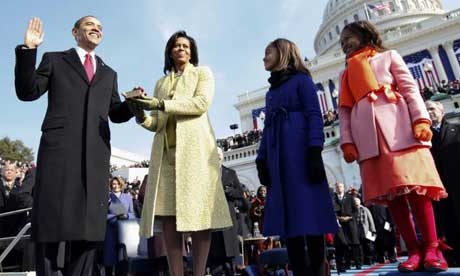
I was extremely disappointed with the over-coverage of Michelle's dress on Inauguration Day. I wanted to hear speculation on her participation in policy issues as First Lady, what strengths she brings to the office and what goals she hopes to accomplish. Instead, I heard a barrage of descriptions about her clothing.
I can't remember what news channel I was watching (I was switching back and forth between a few), but I remember the male commentator announcing that Barbara Walters would be joining him for insights into Michelle Obama on this monumental day. I leaned forward in my seat. This is what I'd been waiting for! The witty, intelligent, forward-thinking Barbara Walters to talk about the real Michelle.
Not so.
Barbara came on for a mere 5 minutes and talked ONLY about Michelle's dress.
Every newspaper and magazine carried detailed description of what Michelle wore, including mention of her designer, Isabel Toledo. Most also mentioned what Barack wore, in nondescript sentences like this one: President Barack Obama wore a red tie and white shirt with his suit.
Why this overemphasis on women's fashion? It hearkens back to our culture's obsession with women's appearance: our body types, what we wear, how much money we spend on our looks.
Perhaps the saddest part of this whole spectacle is that the Obama daughters, Sasha and Malia, are being socialized the same way. Yahoo News said, "Their daughters were style icons in their own right," and then proceeded to describe, in detail, what the girls wore. No one praised their intelligence or their character.(The headline for the article containing the above picture read, "Obama women give inauguration ensembles modern twist: Orange and pink is the new red, white and blue")
So after all of this news coverage, I began to feel like Michelle was yet another victim of society's obsession with fashion. But what if she used this obsession to her own benefit?
Here's my thought: Michelle's inauguration dress was made by a Cuban-born designer. What if this, in itself, was a political statement? Perhaps a response to Amercians' outcry during the campaign that Obama was a Communist? Perhaps an attempt to bring visibility to our immigrant community?
In my Gender Lens Fantasy, I picture this conversation the night before the Inauguration:
M: Ugh, I just don't know what to wear tomorrow.
B: It's just a dress. Besides, you look great in everything.
M: It's not just a dress. Every news outlet everywhere will be scrutinizing it down to the last thread. You just wait.
B: It will be OK.
M: I just wish I could make a more lasting contribution in this role as First Lady. I don't want to comment on fashion. I want to comment on foreign policy, immigration issues, my own vision for justice.
B: But it's just a dress, honey. A dress can't do that.
M: What if it could? Everyone will be talking about it anyway. What if I wear a dress that forces them to talk about political issues as well?
B: It's just a dress.
And maybe it is just a dress. But maybe not. Maybe Michelle Obama is finding a way to talk back to the system of gender oppression while still working within it. Maybe she's pretending to acquiesce to the gender expectations she's given while simultaneously transforming them. Maybe.
Posted by
Rebecca Lauren
at
8:14 AM
0
comments
Labels: fashion, media, news, politics, television
Tuesday, November 4, 2008
The West Wing and art as prophecy
Several years ago, the brilliant writers of the TV show The West Wing envisioned a relatively unknown Congressman's rise to the presidency. A Congressman of color.
At the time, it seemed mere fiction. We all knew that only white men who were entrenched in the political system were eligible for the presidency, or at least it seemed that way.
But The West Wing artists must have known that things could be different. They dared to create a picture of a different future.
My partner and I have been noting the distinct similarities between the West Wing seasons and the current election, and Brian Stelter of the NY Times just articulated them in a brilliant article this week:
"When Eli Attie, a writer for “The West Wing,” prepared to plot some episodes about a young Democratic congressman’s unlikely presidential bid, he picked up the phone and called David Axelrod...
Days after Mr. Obama, then an Illinois state senator, delivered an address to the 2004 Democratic National Convention, the two men [Attie and Axelrod] held several long conversations about his refusal to be defined by his race and his aspirations to bridge the partisan divide. Mr. Axelrod was then working on Mr. Obama’s campaign for the United States Senate; he is now Mr. Obama’a chief strategist.
Four years later, the writers of “The West Wing” are watching in amazement as the election plays out. The parallels between the final two seasons of the series (it ended its run on NBC in May 2006) and the current political season are unmistakable. Fiction has, once again, foreshadowed reality."
Consider this clip from The West Wing where Matt Santos begins his run for the presidency. Sound familiar?
If you're a West Wing fan, then these similarities might further confirm your suspicions that The West Wing is the best show to ever hit television. But I think this scenario teaches us a lot more than that.
As I sit here at my laptop with CNN computing exist polls in the background, I'm realizing that the visions of the West Wing's creative staff members are becoming reality. Not that I'm giving The West Wing sole credit for Obama's projected win in this election, but I do believe that in order to create a reality, we first have to be able to imagine that it could be so.
The West Wing did that for us as a nation. For the years that it was on TV, I heard people say things like, "Man, I wish Martin Sheen or Jimmy Smits could run for President." The truth is, we didn't want Martin Sheen the actor to run for office; we just wanted someone who wasn't afraid of their own humanity (think President Bartlet's MS), someone who knew a little bit about real life (think Jimmy Smits' character and his desire to send his kids to a public school), someone who talked about justice and meant it (think the entire West Wing staff).
We wanted the possibility of the dream becoming a reality.
As a poet, people often ask me why I write. It certainly doesn't earn me any money or fame. It doesn't carry with it any tangible results. In fact, most times, I write without knowing if anyone will ever read it.
It's times like these that make me remember why we continue to persist as artists -- because it's about creating a vision. I write because I want to make sense of my world and imagine new ways of being within it.
Shows like The West Wing did that for us as a nation.
As we watch tonight as our first African American president takes office, let's remember that it all starts with a vision. It should make us ask, "What can we conceptualize for women? How can we imagine new realities for our gender?" We begin with a small figment of our imagination that, with a little culling, becomes a reality. This is our path to equality.
Posted by
Rebecca Lauren
at
6:26 PM
1 comments
Labels: arts, politics, television
Friday, October 10, 2008
Hallowing Gender
In case you haven't noticed the growing inclusion of giant spiders and ghastly orange pumpkins in the windows of nearly every commercial establishment in the U.S., let me be the first to remind you: 'Tis the season for Halloween.
For kids, this is a time of fun and innovation. For parents, it often means a lot of money and/or time spent on finding/making the perfect costume. (Mom -- think the Philly Phanatic costume you made for my brother out of green fuzzy fabric, cardboard, and an intricate welding of party-blowers...) For us childless twenty-somethings, Halloween means buying a whole bunch of our favorite candy and praying that very few kids knock on our door so we can EAT IT ourselves. :)
Halloween is an interesting time for gender observations because it's the holiday that is most conducive and, simultaneously, most restrictive for gender-bending. I remember, for instance, the majority of the guys in my eighth grade class coming to school dressed as women. For an example of the ridiculous costumes available for men, check out Amy's great blog that I've added to my blog roll. Eek.
But for many small children, Halloween is a time to strictly conform to gendered expectations. Go to any elementary school parade, and you'll most likely see girls dressed as princesses, and boys dressed as superheroes. The problem is that these roles enhance the dichotomy, which states that boys are supposed to be active and girls are supposed to be passive. This is evident in our most basic fairy tales -- the girl is the princess who needs rescuing, and the boy is the rescuer.
Books like the recent Christian bestseller Wild At Heart convince men to embrace these roles as the active, manly rescuer, the pursuant of adventure.
There's nothing wrong with the idea that men are active and risk-taking. The problem occurs when we as a culture assign the trait of adventure to men and men alone.
When we tell women that it is in their nature to be passive and nurturing, we often forget to encourage them to stand up for themselves, to take risks, to disagree when necessary, and to strive for their goals. When we tell men that it is in their nature to be active, we often forget to allow them the freedom to compromise, to display their authentic emotions, and to nurture their children.
It's fascinating to see the ways that these dichotomies play themselves out in Halloween costume selection. Take a look at just one website, specializing in Halloween costumes. They separate their costume selection into girls' costumes and boys' costumes. The girls' costumes consist almost exclusively of princess outfits, while the boys' are almost entirely superheroes. Note, too, how the girls are posed passively, as if modeling the costumes for someone else's gaze. The boys, however, are posed actively, as if they are ready to fight.
Dichotomies hurt both men and women.
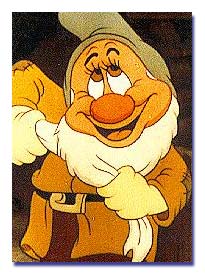
And yet it is clear that these dichotomies are taught not innate. For instance, my brother and I had a set of the seven dwarfs from Snow White. We'd play with them for hours on end. I was completely convinced that Bashful was a woman, despite the obvious evidence to the contrary. My parents actually had to clarify that ALL the dwarfs were male, despite Bashful's long eyelashes. Similarly, I was shocked when I discovered that Big Bird was a boy. I had so identified with his leadership and fun, that I just assumed that he was a girl like me.
When I think back to my own childhood, I remember the moments of strict gender conformity during Halloween -- I was Snow White one year, and my brother was Prince Charming. (OK, ignoring the odd incestuous implications of that one...let's move on...) My parents, however, were the dwarfs. Even now, this strikes me as so odd! A complete reversal of roles. My parents were obviously taller, yet they dressed as dwarfs. My mom was obviously female, but she donned a gray beard. So, maybe my brother and I were blessed because even in the midst of our moments of ultimate gender conformity, we were shown the freedom to be whatever we wanted to be.
Posted by
Rebecca Lauren
at
5:54 AM
1 comments
Labels: childhood, movies, television, traditions
Friday, September 5, 2008
Oprah: Feminist Theologian??

This past weekend, a small sliver of a dream came true for me. I got the chance to see Oprah.
No, I didn't land free tickets to her show or open my front door in my jammies to see her camera crew there waiting to whisk me off to Neverland.
Instead, my partner and I went to hear her speak in Steadman's hometown of Whitesboro, NJ to a small crowd of 500 people. (In fact, all pics in this entry are c/o my partner Joe You rock, babe.)
And she was everything I hoped she'd be: confident, funny, motivating, emotionally moving, and theological.
Yes, theological. And not only that, her stories reflected a theology that empowered women, something we don't always encounter in churches these days.
Oprah told the story of how she had auditioned for the movie The Color Purple and then heard nothing about the part for weeks. She couldn't remember wanting anything more.
Then Joan Rivers called her "fat" on national television, and Oprah vowed to visit a fat camp. She was running on the track, feeling sorry for herself, when she realized that she needed to "give everything to God," the movie role, her anxiety over it...everything.
As she walked off the track, she felt relieved.
Just then, a woman in a purple coat came running towards her, telling her that Steven Spielberg was on the phone. She'd gotten the part.
Now, this post is not meant to be a lesson in prosperity theology. Instead, what I found interesting in Oprah's talk were the ways that she reclaimed religious language in an almost feminist way.
I expected her to sermonize about how important it is that we [as women] give up control of our lives to God. This is a fairly typical viewpoint in Christian theology. In fact, there are numerous worship songs that are popular in churches today with lines like "less of me; more of You," "I decrease so He increases," etc.
The problem with this theology, particularly for women, is that it encourages us to literally become less of ourselves. For some women, this can manifest itself, quite literally, in anorexia. For others, it appears in a quiet meekness, a hesitancy about ourselves, an overall lack of self-confidence, or worse, a deep manifestation of self-loathing.
In truth, if we become nothing, we remain nothing. God is a God who works through responsive, active human beings. Consequently, I believe that when we become more of our true selves, we embrace God's transformational power. When we love ourselves, we are able to love others. When we love what God has created in us, we are more able to create positive change in the world.
And this is essentially what Oprah told the crowd. When she let go of the Color Purple role and gave it up to God, she was saying, "I've done my part. Now it is up to the universe." She didn't say, "I became nothing, so that God could be something."
She didn't discredit the importance of her own agency in this process. In fact, she said that she never would have gotten the part had she not practiced, auditioned, and made the follow-up phone call.
This is so different from the author friend of mine, who, when she got offered an incredible 2-book deal from her publisher said to me, "Well, I didn't do anything. It was all God."
Now let me be clear. I'm not against giving God credit. I just think it's important that we, as women, recognize the vital importance of our human agency in creating positive change in the world.
Oprah puts it this way: "Every morning, I pray that God will show me how I can do something greater than myself."
Posted by
Rebecca Lauren
at
11:57 AM
0
comments
Labels: language, media, religion, television
Sunday, August 31, 2008
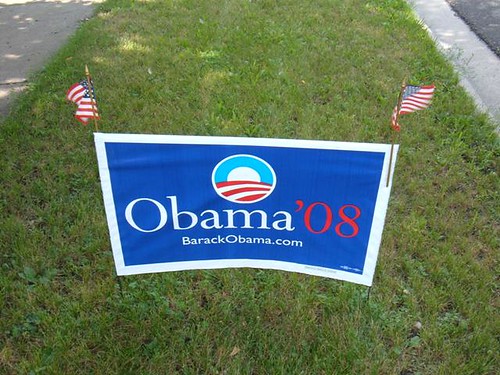
Time to change the lawn signs, Mom
It's hard to believe, but in 2004, my mother (think: church-going feminist matriarch in small town) was a staunch George W. Bush advocate.
I couldn't believe it myself, but when I returned home to visit the fam one weekend that year, I was bowled over by a collection of what I've not-so-affectionately begun to call "Bushy" lawn signs in my parents' front yard.
Her affinity for the Republican party didn't stop there. She also became an official "Bushy" representative for her church, and she's received a Christmas card from the Bushies ever since.
But this was all before Barack Obama's inspired speech this week, in which he accepted the Democratic party's nomination for president. Here is a selection of the furtive text messages I received from my mother throughout his 42 minute speech (which, honestly, was so gripping that it felt like 5 minutes):
are you watching. You are making a democrat out of me
You have to admit that i can keep an open mind. I am loving this! I love that he is young and enthusiastic! I adore his wife. Love that his mom made him study at early hours of am. Sound familiar? I even like joe biden and his wife. Am I turning into a liberal? Love this!!!
So my dear Republican mother is a convert, as are many previously-Republican women this election. Some of the reasons are those my mother stated in her texts: Obama is visionary, easy to relate to, and dedicated to social change.
But I also wonder if women are supporting him this election because, like many previous candidates, he doesn't just sweep women's issues under the rug. Consider his recent speech. In 42 minutes, he mentioned the following key issues for women:
1. Equal pay for equal work. The glass ceiling is still a reality for many women today. Women still make 76.5% of what men make.
2. Women's reproductive decisions. Many feminists believe that a woman's right to choose what to do with an unplanned pregnancy is an important right for women to possess. I happen to be pro-choice but anti-abortion, meaning that I believe that women should have the right to make their own decisions in regard to their pregnancies, but I personally believe that abortion is not often the best moral/physical/emotional decision. Obama's commentary on this issue was great because he acknowledged that both sides of the debate can come together and work towards preventing unwanted pregnancies in the first place. While some feminists might say that he didn't go far enough, I'd commend him for bringing up such an important topic in such a vital and visible speech.
3. Rights for gay and lesbian couples. While skirting the issue of gay marriage, Obama had this to say: "I know there are differences on same-sex marriage, but surely we can agree that our gay and lesbian brothers and sisters deserve to visit the person they love in the hospital and to live lives free of discrimination." Again, while some feminists would have liked to have seen him articulate a clearer stance on the issue, it's certainly groundbreaking for a candidate to so confidently mention gay and lesbian issues in his nationally-televised nomination speech.
What's refreshingly encouraging to me about Obama is that he's made women's issues visible to America. In fact, he's taken them out of the realm of "women's issues" and made them American issues. Finally, we have a candidate who isn't afraid to acknowledge that gender discrimination is still a reality in the U.S.
So, Mom, I guess it's finally time for you to change your lawn signs. :)
Posted by
Rebecca Lauren
at
6:03 AM
2
comments
Labels: media, politics, sexuality, television
Wednesday, August 27, 2008
Keep going
If you missed Hillary Clinton's speech last night at the Democratic National Convention, you should thank your lucky stars for YouTube. These words that will most certainly go down in history brought Bill Clinton, myself, and countless others to tears. OK, I know you're thinking that Bill and I are just saps when it comes to this kind of thing, but take a look for yourself at my favorite 3 minutes of Hillary Clinton's moving speech:
You can read the text here. Even if you're not a Clinton supporter, Hillary has become a symbol of women's progress in this country. Granted, it seems a little crazy that it took us until the 2000's to have a female presidential candidate, but here we are...finally.
I'll leave you with some of her prophetic words. (Don't worry. Bill and I won't tell anyone if you shed a tear):
I'm a United States Senator because in 1848 a group of courageous women and a few brave men gathered in Seneca Falls, New York, many traveling for days and nights, to participate in the first convention on women's rights in our history.
[By the way, for a brilliant account of this fight for the vote, check out the film Iron-Jawed Angels, starring another Hilary (Swank).]
And so dawned a struggle for the right to vote that would last 72 years, handed down by mother to daughter to granddaughter -- and a few sons and grandsons along the way.
These women and men looked into their daughters' eyes and imagined a fairer and freer world, and found the strength to fight. To rally and picket. To endure ridicule and harassment and brave violence and jail.
And after so many decades -- 88 years ago on this very day -- the 19th amendment giving women the right to vote became enshrined in our Constitution.
My mother was born before women could vote. My daughter got to vote for her mother for president.
This is the story of women and men who defy the odds and never give up. How do we give this country back to them?
By following the example of a brave New Yorker , a woman who risked her life to bring slaves along the Underground Railroad.
On that path to freedom, Harriet Tubman had one piece of advice.
If you hear the dogs, keep going. If you see the torches in the woods, keep going.
If they're shouting after you, keep going.
Don't ever stop. Keep going.
If you want a taste of freedom, keep going.
And even in the darkest of moments, that is what Americans have done. We have found the faith to keep going.
Posted by
Rebecca Lauren
at
10:12 AM
0
comments
Labels: media, politics, television
Wednesday, June 25, 2008
Really, Alex.
He looks like a dufus in this picture, and tonight, he looked like a dufus on the show.
Just after anouncing that the Final Jeopardy category would be "The Heisman Trophy," host Alex Trebek quipped, "Uh oh. All the ladies just went ughhh."
Of course, the camera was focused on Alex and his amazing blue question board, so we couldn't see if the ladies did indeed slump towards the floor like sacks of potatoes in utter despair over a SPORTS category, of all things, or if they held their heads high.
What we did see was both "ladies" answering the question perfectly.
Really, Alex. Aren't we past this ignorance of women's interest in sports? Apparently not.
When I was twelve, my brother and I had the entire Philadelphia Phillies roster memorized. I played Little League with Mike Schmidt's number 20 proudly stamped on my back. We loved everything baseball.
Yet when my grandparents waited in line to get Mike Mussina's autograph (my dad had coached against his high school team), I ended up with his scrawled signature across the newspaper scrap that announced his visit, while my brother got a crisply signed new baseball, complete with one of those nifty plastic baseball holders.
Sibling rivalry, or gender disparity? This is why it's so complicated for women today. We sense that something is off, but we can't quite articulate it.
Consider this: from the moment we could walk, my brother and I were wielding plastic whiffle ball bats. My dad taught my brother to bat left-handed, even though he threw right-handed. It was an advantage against most pitchers. But I was just a girl. I was never taught to switch hit.
To be fair, my dad is quite the pro-feminist guy. I mean, how many other dads encouraged their pre-teen girls to play baseball with the boys?
Still, if we as a society can't get past these rigid gender roles, starting as early as childhood, we will continue to communicate, as Alex did tonight, that women are largely ignorant of sports. They're not cut out for it.
Well, Alex, Title IX was passed in 1972, and women are interested in sports: playing them, watching them, rooting for their teams.I can't close this Jeopardy-related post without throwing up a cheer for Larissa Kelly, who became the third all-time money winner in non-tournament Jeopardy play this May. She's the highest female scorer in Jeopardy history. Great job, Larissa! Way to show Alex that women know about not only sports, but quite a bit of everything else as well!
Posted by
Rebecca Lauren
at
4:42 PM
0
comments
Labels: childhood, sports, television