For many of the last few posts, I've focused on gender issues in the United States, particularly in regard to politics. Now, however, I'd like to introduce a new feature of this blog: the International Gender Lens.
Every few months, I'll be interviewing folks who live in other parts of the world, asking them what their noticing about gender constraints in their neck of the woods. My hope is that this will help us as feminists see things a bit more globally, allowing us to widen our sense of "women's issues" to include more than just an American agenda.
Granted, I haven't traveled very far for this first entry. I mean, for goodness' sake, we share a border with Canada already. However, Quebec is a place with a unique identity, one that doesn't always conform to those of its geographic neighbors.
Enter my best friend since first grade, Sarah. After college, Sarah moved north to Quebec City and has lived their ever since. She's married to a Quebecois and teaches English as a second language. She's also studying literature.
First, a little explanation of this picture. After a 12 hour train ride to visit Sar, I looked across the station in Montreal to discover...well...my twin. As you can see, Sarah and I are wearing pretty much the exact same pink and brown striped sweater. This is a pretty good example of how in sync we are, even from many miles away.
Not to stretch this metaphor too far, but this is the kind of thing I'm hoping for in the International Gender Lens: the experience of traveling all over the world only to find that women have more in common with one another than we might think. While recognizing our different struggles, we can find allies in each other. This is my hope.
RL: What's one negative gender issue that you notice in Quebec that you didn't notice in the U.S.?
SM: In Quebec, where I now live after growing up in central Pennsylvania, women must keep their maiden name at marriage. This is great…a tenet of the feminist credo. The problem is that women married in Quebec cannot choose to take their husband’s last name if they desire to do so. Even more creative solutions to the “last name dilemma,” such as a combination of the husband’s and wife’s last name are not permitted. So can this political stance be considered feministic or simply restrictive?
Freedom of choice is one of the core values of our post-modern society. So Quebec’s supposedly-feminist stance forcing women to keep their maiden names is in fact as limiting as laws obliging women to take their husbands’ names. Some women, even self-identified feminists, would choose to take their husbands’ names. One reason is so that their families can be identified as a unit, each member having the same last name.
Since married couples cannot share the same last name, this law complicates choosing last names for children. If given a name combining the last names of both parents, the children now have different last names than both their parents. It becomes even more complicated when children with hyphenated last names marry other children with hyphenated names. What names do they choose for their children? Will their children have four last names? Most likely not; so a choice will have to be made. In most cases in Quebec, couples in this predicament choose the last names of their fathers, which is just as patriarchal as the traditional system.
This “last name debate” reminds me of Ammu’s dilemma in Arundhati Roy’s The God of Small Things. Although her twins were seven years old, she still had not given them a last name:
"For the time being they had no surname because Ammu was considering reverting to her maiden name, though she said that choosing between her husband's name and her father's name didn't give a woman much of a choice."
I want women (and men) to choose the last name that they deem the best solution for them. It bothers me that my government dictates to women that the only way to be feminist is by keeping their fathers’ names.RL: What's one positive development in regard to women that you appreciate about Quebec?
SM: Quebec has actively promoted a gender-equal society. One way that the Quebec government has done this is by instating a public daycare system that only costs the users seven dollars a day. This means that many mothers can work without exhausting most of their income on child care. The program’s raison-d’être is, “to help parents balance their work and family responsibilities."
Another of Quebec’s policies, its Quebec Parental Insurance plan, inaugurated in 2006, has led to greater gender equality in the workplace. One year “maternity” leave now includes fathers, so men no longer have an advantage when applying for a job since the employer recognizes that a man may choose to take parental leave. Employers that had been weary of hiring women because she may take a year’s maternity leave cannot justify such a decision any longer.
Couples have taken advantage of this program. In Canada about 90% of mothers took leave from their jobs. In Quebec, 80% of men choose to take parental leave. (2006 figures).
One reason that so many Quebecers have used the program is that the policy is very flexible. The parents can choose to split or even share the year. The government provides seventy-five percent of the salary and employers are required to retain the same position for when the worker returns to work. The government pays up to 75% of the salary the person is missing during the leave.
3. Can you share a moment this very week where you personally encountered a gender issue?
Well, I've spent most of this week studying, so I guess I'd say that when I think of education, I'm grateful that I live today and not even 100 years ago. Also, I know that even if I do have kids, I can continue my education as a mom. I don't know if it's the same in the States, but moms can get the same grants and loans going part-time to college as those without kids get as full-time students.
Friday, February 6, 2009
International Gender Lens: QUEBEC
Posted by
Rebecca Lauren
at
9:31 AM
1 comments
Labels: international gender lens, marriage, parenting, politics, traditions
Thursday, February 5, 2009
The American Virgin
I just had to take a minute to introduce a new addition to my blogroll: The American Virgin. Inspired by Therese Schechter's documentary of the same name, this blog chronicles current events surrounding the topic of virginity.
And wow, is it ever fascinating stuff.
Here's just a sneak peak from today's post:
From the website of The Passion For Christ Movement where you can order your own Ex-Masturbator t-shirt.
No lie.
Posted by
Rebecca Lauren
at
4:50 PM
3
comments
Labels: sexuality
Tuesday, January 27, 2009
Top Chef? Or Top Chauvenist?
Add in a pinch of sexism and a dab of meritocracy, and what do you get? An interesting impromptu Facebook conversation about Bravo's hit reality TV show, Top Chef.
A little background info: Stefan is one of the remaining contenders. He seems to be a good cook, but he's quite full of himself, and no one wants to work with him because his attitude is horrible. I've been rooting against him just about every episode, but last week, when the freezer broke and he was supposed to make a frozen dessert, I marveled at the fact that he figured out a way to make it work. I thought this was innovation. My friend, CR, however, thought this was a sure marker of privilege.
Here are bits of our conversation (admittedly rushed, off-the-cuff, and written in haste as we both tried to avoid grading papers)...
CR:I wouldn't care if Stefan managed to freeze that dessert by holding individual ice cubes up to it for 4 hours straight. Ugh. Ugh. I happen to think a lot of that "find a way to make it work" mentality is all about growing up with privileges that lead you to believe that you can do and be anything you want. I think that is why we see it much more often in men than women. I don't know Stephan's background (beyond being white and male), but I'd be willing to bet that he is middle class or upper class. Put all those things together and the world is much less likely to tell you that you can't do things.
RL: Fascinating insight, but I could argue the complete opposite. I mean, doesn't growing up with little mean that you have to be innovative to make the best of it? Some of the best recipes come when there is nothing in the house, and you have to figure out what to do with what is left. So, having less means that you are forced to be more creative. You say that being a WASP means that "the world is much less likely to tell you that you can't do things," but doesn't that mean that you also never have anyone challenging you? If people always like what you have to offer, then where is the motivation to get better? And you have to admit, Stefan is a decent chef. I just hate his attitude. I mean, the show isn't judging him on whether or not he's a selfish pig. They're judging him on how he cooks. And the man can cook.
CR: I do agree that he seems to be a good chef. I will also say, though, that the show has a history of what I see as sexism and classism. It seems very much like the judges have an idea of who they think deserves to win from the very beginning. Then there were the comments at the end of last season when the win of a woman (the first one to get so close!) who consistently made really good food was downplayed because "it was Richard's to lose" rather than hers to win. I don't know, but that spoke volumes to me. Her food was good; she proved it over and over again, yet it wasn't hers to win but someone else's to lose. Someone else who also made good food but far less consistently. Of course, the show is scripted to a certain degree, and choices are no doubt influenced by producers who are trying to keep the drama going. I guess what I'm getting at here is that I think Stefan has an advantage -- one that does not rest on merit.
And I see what you are saying about having to be creative, but that's really different than what happens on the show. Making a meal for 5 with nothing but rice, a can of pickled beets, and processed cheese is one thing. It requires invention and creativity, but historically I don't think that kind of creativity has been nearly as heralded as, say, making some kind of gourmet food with all sorts of unlimited resources.
I also see *having* to be creative as different than growing up with a feeling that you can do anything. If you are doing miraculous things in the kitchen with $30 worth of groceries every week you are still very likely being beaten down in a variety of ways. The overwhelming message is that you aren't as worthy or good as the next person. In the end, I'm not so sure that it would matter about those $30 worth of groceries and what you could do with them.
RL: Sensei, you are very wise. Very wise indeed. I completely agree with you about the sexism at the end of last season. And I think that Stefan certainly has had advantages that, say, Gene [Hawaiian contestant who worked his way up from a dishwasher to a chef], did not, and that's definitely a class thing.
But the problem with any meritocracy is that it's nearly impossible to simply measure pure merit. We are always measuring class as well. For instance, I'm thinking about kids in elementary school as they're learning to read. The teacher is measuring their "ability" to read, but he/she is also subconsciously measuring how much time the child's parents spent reading with him/her outside of school. Often, in working class households, there isn't much available reading time. So what is the teacher really measuring? What class you were born into?
I guess what I'm saying is that to enjoy a show like Top Chef, I as the viewer have to pretend that it's all about merit. I'm sorry that Gene spent years washing dishes instead of being exposed to the culinary possibilities that Stefan was likely exposed to, but there's no way to even the playing field after the fact. It's not like we can say, "Hey Stefan, stop cooking for a few years so Gene can catch up." I have to judge them on the food they put on the table. And Stefan seems to cook good food.
CR: I completely agree with you about there being no such thing as pure merit, and your example is a perfect one. Where we seem to differ is the ability to do the kind of pretending you described. I can't watch the show without seeing it. I think that is probably what makes you the more optimistic one and makes me the grumpier one. I honestly see positive things in both approaches.
In order for me to not throw myself into moving traffic I have to believe that acknowledging it does make a difference and while I agree that it is difficult to figure out how to level the playing field, I think it is vitally important that we try. And I'm not saying that you don't believe that because I think you do. I'm just saying that for me not to see those things makes me feel (more) complicit.
RL: I know what you mean about not being about to ignore the sexism and classism when trying to watch the show. In fact, it drives my partner nuts because we'll be watching TV and he'll say, "I really like this commercial," and I'll go off on a rant about all the ridiculous oppression happening all over the place. Poor thing is usually like, "Oh. I didn't see that."
But I guess my point in "pretending" was that there's no way in the competition itself to level the playing field. The groundwork has already been laid (eek, lain?), and there's not much to do but sit back and laugh at the spectacle. And Stefan certainly is a spectacle.
But you're also right in saying that when we stop noticing, we become complacent, so I'm always glad for you noticing these things because they remind me to notice.
Posted by
Rebecca Lauren
at
5:32 PM
1 comments
Labels: arts, class, television
Friday, January 23, 2009
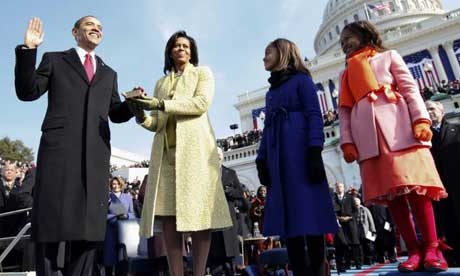
Obsessed with the dress
She has degrees from Princeton AND Harvard. Her secret service code name is "Renaissance." But what we're most concerned about as a nation is what she's wearing.
The Guardian states that she is now the most powerful woman...
in fashion.
I was extremely disappointed with the over-coverage of Michelle's dress on Inauguration Day. I wanted to hear speculation on her participation in policy issues as First Lady, what strengths she brings to the office and what goals she hopes to accomplish. Instead, I heard a barrage of descriptions about her clothing.
I can't remember what news channel I was watching (I was switching back and forth between a few), but I remember the male commentator announcing that Barbara Walters would be joining him for insights into Michelle Obama on this monumental day. I leaned forward in my seat. This is what I'd been waiting for! The witty, intelligent, forward-thinking Barbara Walters to talk about the real Michelle.
Not so.
Barbara came on for a mere 5 minutes and talked ONLY about Michelle's dress.
Every newspaper and magazine carried detailed description of what Michelle wore, including mention of her designer, Isabel Toledo. Most also mentioned what Barack wore, in nondescript sentences like this one: President Barack Obama wore a red tie and white shirt with his suit.
Why this overemphasis on women's fashion? It hearkens back to our culture's obsession with women's appearance: our body types, what we wear, how much money we spend on our looks.
Perhaps the saddest part of this whole spectacle is that the Obama daughters, Sasha and Malia, are being socialized the same way. Yahoo News said, "Their daughters were style icons in their own right," and then proceeded to describe, in detail, what the girls wore. No one praised their intelligence or their character.(The headline for the article containing the above picture read, "Obama women give inauguration ensembles modern twist: Orange and pink is the new red, white and blue")
So after all of this news coverage, I began to feel like Michelle was yet another victim of society's obsession with fashion. But what if she used this obsession to her own benefit?
Here's my thought: Michelle's inauguration dress was made by a Cuban-born designer. What if this, in itself, was a political statement? Perhaps a response to Amercians' outcry during the campaign that Obama was a Communist? Perhaps an attempt to bring visibility to our immigrant community?
In my Gender Lens Fantasy, I picture this conversation the night before the Inauguration:
M: Ugh, I just don't know what to wear tomorrow.
B: It's just a dress. Besides, you look great in everything.
M: It's not just a dress. Every news outlet everywhere will be scrutinizing it down to the last thread. You just wait.
B: It will be OK.
M: I just wish I could make a more lasting contribution in this role as First Lady. I don't want to comment on fashion. I want to comment on foreign policy, immigration issues, my own vision for justice.
B: But it's just a dress, honey. A dress can't do that.
M: What if it could? Everyone will be talking about it anyway. What if I wear a dress that forces them to talk about political issues as well?
B: It's just a dress.
And maybe it is just a dress. But maybe not. Maybe Michelle Obama is finding a way to talk back to the system of gender oppression while still working within it. Maybe she's pretending to acquiesce to the gender expectations she's given while simultaneously transforming them. Maybe.
Posted by
Rebecca Lauren
at
8:14 AM
0
comments
Labels: fashion, media, news, politics, television
Thursday, January 22, 2009
Saturday, January 17, 2009
Our New Superhero!
Love it.
Thanks go to Ms. Magazine for offering a free Inauguration poster with a year's subscription. Too tempting for this feminist to pass up!
And yet, a friend of mine on Facebook just joined the group "My Father's last day," which is meant to celebrate George W. Bush's final day in office. The group description reads, "Say goodbye to 8 years of my father doing everything he could to try and make America a better place every day."
Instead of attending another celebration of yet another patriarch who's done very little for women, I'm going to join Ms. Magazine in welcoming the antithesis of a patriarch, and dare I say, a FEMINIST.
So polish your gender lenses, ladies and gentlemen. This superhero is sure to bring new sight for sore eyes.
Posted by
Rebecca Lauren
at
6:25 PM
5
comments
Tuesday, December 30, 2008
Don't resolve. Reflect.
This New Years in lieu of the latest diet trend, maybe we could all consider a more meaningful and/or altruistic goal for the next 365 days. Here are some alternatives:
1. A GREEN resolution that can improve the quality of your own life, and the life of generations to come.
2. Involving yourself in social justice, such as through this new website, which allows you to choose a volunteer project, set goals, and track your progress.
3. An inside change, as recommended by Diane McDonald in the Patriot-Star Ledger.
4. And perhaps my own personal favorite, "Don't resolve. Reflect," take from, of all places, a 1997 editorial in Glamour. My friends and I in high school discovered this incredible little series of reflective questions, and would answer them once a year, seal the answers in an envelope, and read them again the next year to see how far we'd come. It was by far the most successful New Year's plan I've ever enacted. Here it is:
Something in the human spirit seems to demand a ritual at the start of a new year, a metaphoric squaring of the shoulders and clearing of the throat before we take it from the top-and try to get it right this time. And so, we resolve: I will lose ten pounds, volunteer at a soup kitchen, be nicer to my mother. Only to find that our well-intentioned declaratives have exhausted resolve rather than strengthened it-even before Valentine’s Day.
This New Year, we propose an alternative to resolutions: Rather than resolve, reflect. Rather than declare, question. Don’t expect the answers to come easily. Dare to doubt. Be willing to stir up an internal insurrection. Yes, uncertainty can be unsettling. But the answers to these questions can be revealing as well.
1. If I had to wear my philosophy of life as a motto on a T-shirt, what would it be? Of course, no one can be summed up in an epigrammatic sentence or two. But, just for fun, why not try?
2. When was the last time I felt joy? Not just pleasure, joy. Was it provoked by a someone, a something, a somewhere? That soaring feeling still lives inside me. What can I do to wake it up?
3. Is there anything unfinished in my life that I am willing to walk away from forever? If I haven’t thus far learned French, gotten a dog, started my own business, maybe it’s time to make room for new dreams. Hit delete. See what happens.
4. Am I inhibited by a fear of failing? Just for a moment, pretend that failure is a triumph, not a shame. Now what would I reach for, what would I risk?
5. If I were to take my ten-year-old self to lunch, what would she think of me? Do I still have her passions, her opinions, her willfulness? Do I still know what she knows?
6. Do I believe in God? What exactly is my position on the Big Questions? Do I have spiritual belief that are truly my own, not someone else’s?
7. Have I made a home for myself? Or am I still waiting for My Real Life to begin? I already know I don’t have to be married or mortgaged or otherwise permanently committed to nest. So what’s keeping me from saying this is My Real Life now?
8. If I could take a six-month sabbatical from my current job, what would I do? Travel around the world? Perform good deeds? Put my bottom in a chair and my head in a book? If I don’t know the answer, how can I begin to figure out what my dream is?
9. What do I like most about my appearance? What are my secret vanities? Can I be a show-off for a change? Can I strut my stuff on a regular basis?
10. How do I envision myself at 60? What would I like to look like? What would I like to know that I don’t know now? What should I be doing now that I will happily look back on then?
11. Am I living my life for an audience? Have I internalized a watchful someone: Mom, my best friend, an ex-boyfriend? Is my audience worthy of judging me? How can I banish them forever and live for myself?
12. What can I do about the people I have disappointed and been disappointed by? If I could heal a damaged relationship, would I? Is there anyone whose lost friendship and regard I mourn? Or is it time to move on?
13. How much money will I need for retirement? Does simply asking the question make me hyperventilate? Can I stand to do the math? Am I brave enough to begin?
14. Am I as healthy as I want to be? If I imagine myself, circa 2020, how would I like to feel, physically and mentally? What steps should I be taking now to make sure that ideal becomes a reality?
15. Am I capable of being alone? Does the prospect of an entire weekend by myself stimulate or panic me? If I’m not in psychic shape for the occasional bout of solitude, I need to be. Start thinking about what is scary about aloneness and how to overcome it.
16. Do I see success as a lavish banquet or a scarce commodity? When a good friend triumphs, do I feel depleted- as if there’s a limited amount of goodies to go around? Is it possible to transform envy into a this-means-I-can-do-it-too signal?
17. How do I want to love and be loved? What is my definition of a wonderful marriage, partnership, love affair? How close have I come to finding that? What is left for me to do in order to attract the love I want?
Posted by
Rebecca Lauren
at
5:43 AM
0
comments
Labels: traditions